Top view of house model, insurance policy document, house keys, calculator and pen on a light desk
Is Homeowners Insurance Required by Law or Just by Your Lender?

Content
Buying a home represents one of the largest financial commitments most Americans will ever make. As you navigate closing documents and mortgage paperwork, you'll encounter multiple references to homeowners insurance. But is this coverage actually required by law, or just strongly recommended?
The short answer: no state in the U.S. legally mandates that property owners carry homeowners insurance. You won't face fines or legal penalties for owning an uninsured home. However, this technical freedom comes with significant practical limitations. If you're financing your purchase through a mortgage lender, insurance becomes a non-negotiable condition of your loan agreement. Even if you own your home outright, going without coverage exposes you to catastrophic financial risk that could wipe out your equity in a single event.
Understanding when homeowners insurance transitions from optional to mandatory—and why even "optional" coverage remains essential—helps you make informed decisions about protecting your investment.
When Homeowners Insurance Becomes Mandatory
The requirement for homeowners insurance hinges almost entirely on how you're paying for your property. Your financing method determines whether you'll have flexibility or face strict insurance obligations.
Mortgage Lender Requirements Explained
When you take out a mortgage, your lender holds a security interest in your property until you've repaid the loan in full. From their perspective, they've invested hundreds of thousands of dollars in an asset that could be destroyed by fire, wind, hail, or other covered perils. Without insurance, they risk total loss of their collateral.
Every conventional, FHA, VA, and USDA loan program includes insurance requirements in the mortgage agreement. Your lender will verify coverage exists before closing and monitor your policy status throughout the loan term. This isn't a suggestion or recommendation—it's a binding contractual obligation that appears in your loan documents.
The mortgage requirement homeowners insurance policies guide lenders use typically specifies coverage must equal at least the loan amount or the property's replacement cost, whichever is less. If you borrow $300,000 on a home worth $350,000, your lender will require minimum dwelling coverage of $300,000. They don't care if your personal belongings are covered or if you have liability protection—their concern focuses solely on the structure securing their loan.
Most borrowers pay insurance premiums through an escrow account managed by their mortgage servicer. Each month, a portion of your mortgage payment goes into this account, and the servicer pays your insurance bill when it comes due. This arrangement ensures lenders can verify continuous coverage without relying on borrowers to make separate payments.

Author: Ethan Caldwell;
Source: sixth-fleet.com
Cash Purchases vs. Financed Homes
If you purchase a home without financing, no entity can force you to buy insurance. You receive the deed with no strings attached, and you're free to insure or not insure as you see fit. This applies whether you're buying a $150,000 starter home or a $2 million estate.
However, this freedom comes with substantial risk. A major fire could destroy a $400,000 home, leaving you with a mortgage-sized loss and no financial recourse. You'd still own the land, but rebuilding would require either significant liquid assets or taking out a construction loan—assuming you qualify after such a financial hit.
Cash buyers who skip insurance often underestimate the likelihood of claims. According to Insurance Information Institute data, approximately one in 20 insured homes files a claim each year. The most common claims—water damage, wind and hail damage, and fire—frequently exceed $10,000 in repair costs. Without coverage, these expenses come entirely from your pocket.
States Without Legal Requirements: Why You Still Need Coverage
Unlike auto insurance, which 49 states mandate for vehicle owners, homeowners insurance remains voluntary from a legal standpoint across all 50 states. No state legislature has passed laws requiring property owners to maintain coverage, and no government agency will penalize you for an uninsured home.
This legal framework reflects fundamental differences between home and auto ownership. Cars operate on public roads where they pose risks to others, justifying mandatory liability coverage. Homes remain stationary on private property, and an uninsured house doesn't directly threaten public safety or other people's property.
Despite this legal freedom, the homeowners insurance mandatory rules guide that matters most comes from practical financial reality rather than statute books. Consider what you're risking by going uninsured:
A typical homeowner has 65-70% of their net worth tied up in home equity. For many families, this represents decades of mortgage payments and their primary source of retirement security. A total loss without insurance doesn't just mean losing a house—it means losing the majority of your lifetime wealth accumulation.
Liability exposure adds another layer of risk. If someone suffers a serious injury on your property, you could face a lawsuit seeking damages for medical bills, lost wages, and pain and suffering. Without the liability coverage included in homeowners policies, you'd defend this lawsuit with personal assets. A single slip-and-fall case could result in a six-figure judgment against you.
Natural disasters create particularly devastating scenarios for uninsured homeowners. After major hurricanes, wildfires, or tornado outbreaks, news coverage regularly features property owners who lost everything because they'd dropped coverage or never purchased it. These families often face impossible choices: walk away from their property, take on massive debt to rebuild, or live in damaged structures.
While no law requires homeowners insurance, calling it 'optional' misrepresents the financial reality most families face.I've seen clients lose homes worth $500,000 to fire, only to discover they'd canceled their policy six months earlier to save $1,200 annually. That decision cost them everything they'd built over 20 years of homeownership
— Jennifer Martinez
What Happens If You Drop Your Homeowners Insurance
Letting your homeowners insurance lapse or actively canceling your policy triggers a series of consequences, particularly if you carry a mortgage. Lenders monitor insurance status carefully and respond quickly when coverage disappears.
Lender-Placed Insurance and Its Costs
Your mortgage agreement includes provisions allowing your lender to purchase insurance on your behalf if your policy lapses. This "lender-placed" or "force-placed" insurance protects only the lender's interest in the property—it provides zero coverage for your personal belongings, additional living expenses if the home becomes uninhabitable, or liability protection.
Despite offering drastically reduced coverage, lender-placed policies typically cost 2-10 times more than standard homeowners insurance. An annual premium that would cost $1,500 for comprehensive coverage might run $4,000-$8,000 for lender-placed insurance. The lender adds this premium to your mortgage balance or escrow account, and you're responsible for paying it.
The homeowners insurance obligation rules guide lenders follow gives them broad authority to protect their collateral. They don't need your permission to purchase this coverage, and they're not required to shop for competitive rates. Many lenders have relationships with specific insurers that provide force-placed policies, and these arrangements don't always prioritize affordability.
Mortgage Default Risks
Beyond the immediate cost of lender-placed insurance, letting coverage lapse can trigger default provisions in your mortgage agreement. Your loan documents list maintaining adequate insurance as a covenant—a promise you made as a condition of receiving the loan. Breaking this covenant gives your lender grounds to accelerate the loan, demanding immediate payment of the entire balance.
In practice, most lenders won't immediately foreclose over a lapsed insurance policy. They'll first place coverage on your behalf and attempt to collect the premiums. However, if you fall behind on the inflated payments for lender-placed insurance, you could end up in default on your mortgage, damaging your credit and potentially leading to foreclosure.
Some borrowers let insurance lapse because they're struggling financially, viewing the premium as an expense they can temporarily eliminate. This strategy almost always backfires. The combination of lender-placed insurance costs and potential default creates a worse financial situation than maintaining the original policy.

Author: Ethan Caldwell;
Source: sixth-fleet.com
HOA and Condo Association Insurance Obligations
Homeowners associations and condominium associations add another layer of insurance requirements that operate independently of mortgage lender mandates. These requirements appear in your CC&Rs (Covenants, Conditions, and Restrictions) or association bylaws, making them legally enforceable regardless of how you financed your purchase.
Most HOAs in planned communities require homeowners to maintain insurance coverage and provide annual proof of policy renewal. The association's architectural committee or board typically specifies minimum coverage amounts, often requiring liability limits of at least $300,000 or $500,000. Some associations also mandate specific endorsements or additional coverages beyond basic policies.
Condominium insurance creates more complexity because the association's master policy covers certain elements while individual unit owners must insure others. The master policy typically covers the building's exterior, common areas, and shared structures. Your individual HO-6 condo policy covers your unit's interior, personal property, improvements you've made, and liability.
The insurance requirement homeowners property rules guide that condo associations use varies based on whether the development follows "bare walls-in" or "all-in" coverage models. Under bare walls-in, the master policy stops at the drywall, and you're responsible for insuring everything inside your unit, including fixtures, cabinets, and flooring. Under all-in coverage, the master policy includes original fixtures and finishes, and you only insure upgrades and personal belongings.
Failing to maintain required insurance in an HOA or condo association can result in fines, liens against your property, or even legal action to force compliance. Associations take these requirements seriously because an uninsured owner who causes damage to common areas or neighboring units creates liability exposure for the entire community.
How Much Coverage Your Mortgage Lender Actually Requires
Understanding the minimum coverage your lender requires versus what you actually need helps you avoid both over-insuring and dangerous coverage gaps. Lenders focus narrowly on protecting their financial interest, which doesn't always align with comprehensive protection for your situation.
The standard mortgage requirement specifies dwelling coverage equal to the outstanding loan balance or the replacement cost of the structure, whichever is less. If you owe $250,000 on a home that would cost $280,000 to rebuild, your lender requires $250,000 in dwelling coverage. As you pay down your mortgage, the minimum required coverage technically decreases, though most policies don't automatically reduce coverage amounts.
Lenders also require that they be named as a mortgagee or loss payee on your policy. This ensures claim checks for structural damage are made payable to both you and the lender, preventing you from pocketing insurance money without repairing the property that secures their loan.
Here's how lender minimums compare to what insurance professionals typically recommend:
| Coverage Type | Typical Lender Requirement | Industry Recommendation | Why the Difference Matters |
| Dwelling Coverage | Outstanding loan balance | Full replacement cost (often 20-30% higher) | Lender requirement may leave you underinsured if rebuilding costs exceed loan amount |
| Personal Property | Not required | 50-70% of dwelling coverage | Lender doesn't care about your belongings, but replacing everything costs $75,000-$150,000 for most families |
| Liability | Not required | $300,000-$500,000 minimum, often $1M umbrella | Lawsuit judgments can exceed home value; lender only cares about the structure |
| Loss of Use | Not required | 12-24 months of additional living expenses | Without this, you'll pay both mortgage and rent if home becomes uninhabitable |
| Deductible | No specific limit | 1-2% of dwelling coverage for balance of premium and out-of-pocket costs | Lender accepts any deductible, but $5,000+ deductibles create financial hardship for many families |
The gap between lender requirements and adequate protection creates a dangerous situation for homeowners who carry only the minimum. You might satisfy your mortgage agreement while remaining dramatically underinsured for real-world scenarios.
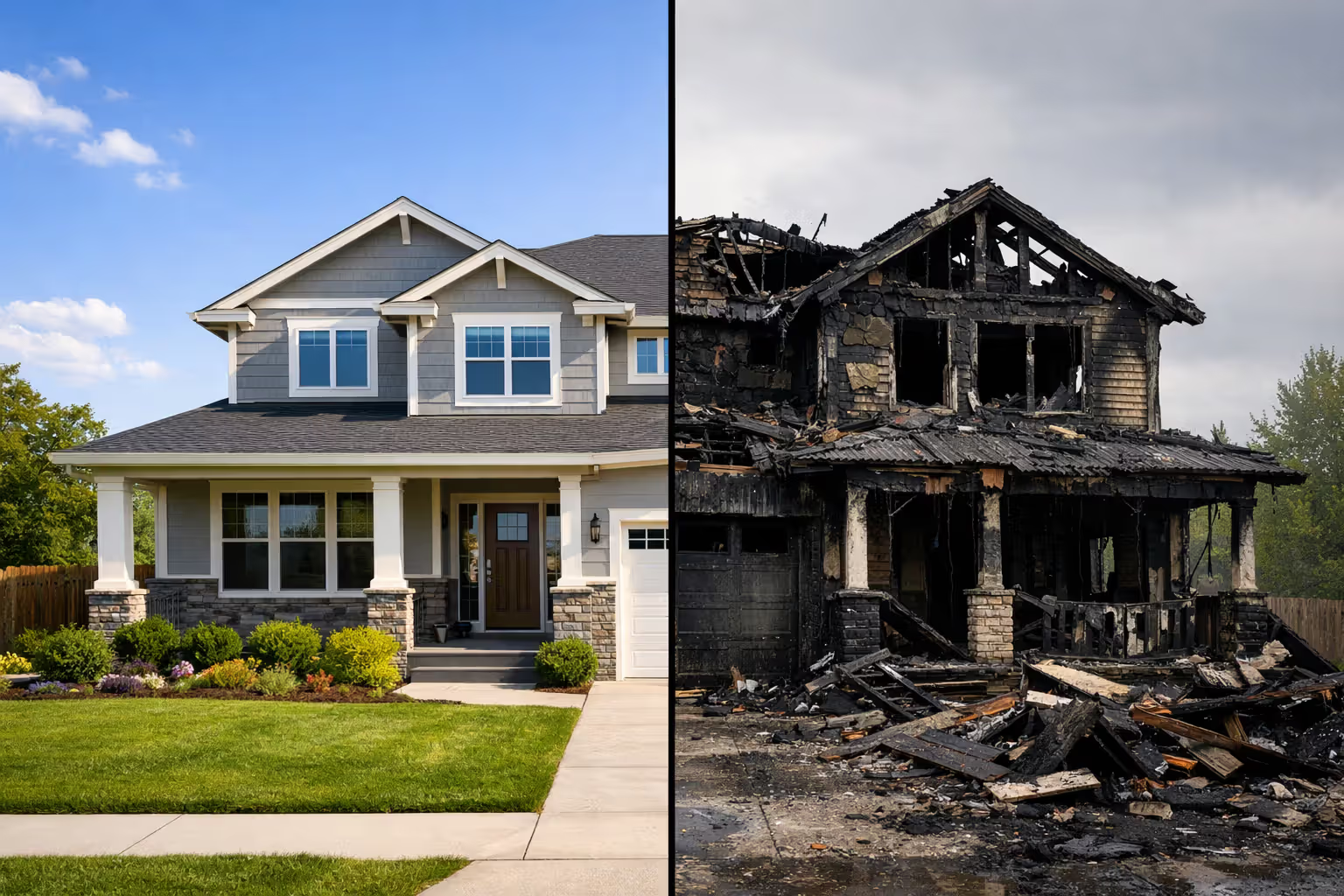
Replacement cost calculations deserve particular attention. Construction costs have increased significantly in recent years due to material shortages, labor costs, and supply chain issues. A home that cost $200,000 to build in 2015 might require $280,000 to rebuild today. If you're carrying coverage based on your original purchase price or current loan balance, you could face a massive shortfall after a total loss.
Author: Ethan Caldwell;
Source: sixth-fleet.com
5 Common Mistakes Homeowners Make With Insurance Requirements
Even homeowners who understand they need coverage frequently make errors that leave them exposed or paying more than necessary. These mistakes often stem from misunderstanding how insurance requirements work or making assumptions without verifying details.
Mistake 1: Assuming escrow payments guarantee adequate coverage. Many homeowners never review their actual policy because their mortgage servicer handles premium payments through escrow. They assume if payments are being made, coverage must be adequate. However, escrow accounts simply pay whatever premium your insurer charges—they don't verify coverage amounts match your needs. You might be paying faithfully for a policy that underinsures your home by $100,000.
Mistake 2: Dropping coverage immediately after paying off a mortgage. The day you make your final mortgage payment, the legal requirement to maintain insurance disappears. Some homeowners celebrate by canceling their policy and eliminating the expense. This leaves them completely exposed to losses that remain just as likely—and just as financially devastating—as when they carried a mortgage. Fire, theft, and liability risks don't decrease because you own your home outright.
Mistake 3: Letting policies auto-renew without reviewing coverage. Insurance needs change as home values fluctuate, you make improvements, or your financial situation evolves. Auto-renewal is convenient, but it locks you into coverage amounts that may no longer reflect your property's replacement cost. After a major kitchen renovation that added $50,000 in value, your policy won't automatically increase coverage to match unless you notify your insurer.
Mistake 4: Misunderstanding what "minimum required coverage" means. When your mortgage documents specify minimum coverage requirements, these protect the lender's interest, not yours. Meeting the minimum satisfies your loan agreement but may leave enormous gaps in protection. If your lender requires $200,000 in dwelling coverage but rebuilding would cost $275,000, you'll be $75,000 short after a total loss—even though you met the requirement.
Mistake 5: Assuming homeowners insurance covers all property damage. Standard policies exclude several major perils, most notably floods and earthquakes. If you live in a flood zone, your mortgage lender will require separate flood insurance, but they won't require earthquake coverage even in high-risk areas. Homeowners in California, Washington, or other seismically active regions often discover too late that their policy provides zero earthquake protection. Similarly, flood coverage requires a separate policy through the National Flood Insurance Program or private insurers, regardless of whether you have a mortgage.

Author: Ethan Caldwell;
Source: sixth-fleet.com
Frequently Asked Questions About Homeowners Insurance Requirements
Protecting Your Investment Beyond Minimum Requirements
The question "is homeowners insurance required" has a nuanced answer that depends on your specific situation. While no legal mandate exists, practical and contractual obligations make coverage essential for virtually all homeowners.
If you're financing your home, insurance transitions from optional to absolutely required. Your lender will enforce this requirement throughout your loan term, and attempting to avoid it will result in expensive force-placed coverage or potential default. Even if you own your home outright, the financial risk of going uninsured far exceeds the cost of premiums for most families.
The more important question isn't whether insurance is required, but whether you're carrying adequate coverage to protect your investment. Meeting minimum lender requirements provides a starting point, not comprehensive protection. Review your policy annually, adjust coverage as your home's value changes, and consider protections beyond what your mortgage company mandates.
Your home represents more than a legal requirement to insure—it's likely your largest asset and the foundation of your family's financial security. Treating insurance as merely a box to check for your lender misses the broader purpose: protecting yourself from losses that could devastate your finances and derail your long-term goals.