Homeowners insurance documents, calculator, small house model and laptop on kitchen table, top view
How to Shop for Homeowners Insurance Without Overpaying or Missing Coverage

Content
What to Know Before You Start Shopping
Walking into the insurance shopping process unprepared wastes time and increases the likelihood you'll miss important coverage details. Before requesting your first quote, gather specific information about your home and clarify what you actually need to protect.
Understanding Your Coverage Needs
Your mortgage lender requires insurance, but their minimum coverage threshold typically protects their investment, not yours. Lenders usually mandate enough dwelling coverage to rebuild the structure, but they don't care whether your policy covers your belongings, provides liability protection, or pays for a hotel if your home becomes uninhabitable.
Start by calculating your home's replacement cost—what it would cost to rebuild from the ground up using current construction prices and materials. This differs significantly from market value. A home worth $350,000 in a desirable neighborhood might cost $425,000 to rebuild, while a $500,000 home in an expensive area could be reconstructed for $300,000. Replacement cost accounts for square footage, materials, architectural details, and local labor rates, not location desirability.
Create a rough inventory of your belongings by room. You don't need serial numbers yet, but estimate the total value of furniture, electronics, clothing, and appliances. Most standard policies cover personal property at 50-70% of dwelling coverage, which may fall short if you own high-value items like jewelry, art, or collectibles.
Check whether your lender requires replacement cost coverage or accepts actual cash value. Replacement cost pays to replace damaged items at current prices; actual cash value deducts depreciation. A five-year-old roof destroyed in a storm might cost $15,000 to replace but has an actual cash value of only $9,000 after depreciation.
The biggest mistake homeowners make is treating insurance like a commodity purchase. They compare premiums without understanding that a $1,200 policy and a $1,800 policy might offer drastically different protection when disaster strikes
— Sarah Mitchell
Documents and Information You'll Need
Requesting quotes goes faster when you have details ready. Gather your property deed or recent appraisal showing square footage, year built, and construction type. Note any updates: roof age, electrical panel upgrades, plumbing replacements, heating system age, and security features like monitored alarms or deadbolts.
Document your home's characteristics: number of stories, basement (finished or unfinished), garage spaces, fireplaces, and any detached structures like sheds or workshops. Insurers price policies differently for a 2,000-square-foot ranch versus a two-story colonial of the same size.
If you're shopping the homeowners insurance shopping checklist guide, include information about past claims on the property (sellers should disclose this), proximity to fire hydrants or fire stations, and whether you're in a flood zone or wildfire-risk area. A homeowners insurance shopping checklist guide should also account for any home business operations, swimming pools, trampolines, or dog breeds that might require additional liability coverage.

Author: Samantha Kessler;
Source: sixth-fleet.com
Where to Get Homeowners Insurance Quotes
The shopping homeowners insurance providers guide landscape includes several channels, each with distinct advantages. Understanding these differences helps you access the broadest range of options without duplicating effort.
Independent insurance agents represent multiple carriers, allowing them to compare policies from different companies on your behalf. They can identify which insurer offers the best rates for your specific profile—perhaps one company gives better pricing for newer homes while another specializes in older properties or coastal areas. The downside: independent agents may not represent every carrier, and some insurers only sell through their own channels.
Captive agents work for a single insurance company. They know their company's products thoroughly and can often explain nuances in coverage, but they can't comparison shop across competitors. If you already have auto insurance with a company you trust, starting with their captive agent makes sense because bundling home and auto policies typically unlocks discounts of 15-25%.
Direct insurers sell policies online or by phone without agents. This model reduces overhead, potentially lowering premiums, but you're responsible for understanding coverage options and selecting appropriate limits. Direct insurers work well for straightforward properties but may struggle with complex situations like historic homes, mixed-use properties, or high-value estates.
Online insurance marketplaces let you submit information once and receive multiple quotes. These platforms save time but vary in quality—some simply sell your information to agents who call you, while others provide genuine comparison tools. Read the privacy policy before submitting personal details.
Consider bundling opportunities seriously. Insurers reward customers who consolidate multiple policies, and the discount often exceeds what you'd save by splitting coverage across different companies. However, run the numbers both ways; occasionally, unbundled policies from different specialists cost less overall.
Regional and local insurers sometimes offer competitive rates that national carriers can't match, particularly if they specialize in your area's specific risks. A Florida-based insurer understands hurricane coverage differently than a national company applying generic risk models.

Author: Samantha Kessler;
Source: sixth-fleet.com
How to Compare Homeowners Insurance Quotes Accurately
Comparing insurance quotes homeowners policy guide documents side-by-side reveals differences that aren't apparent when looking at premium costs alone. Two policies with identical dwelling coverage amounts can provide vastly different financial protection depending on how they define coverage limits, handle depreciation, and structure deductibles.
Coverage Limits That Matter Most
Dwelling coverage forms the foundation, but verify whether the policy offers guaranteed or extended replacement cost. Standard replacement cost coverage pays to rebuild up to your policy limit—if construction costs spike after a major disaster affects your region and your $300,000 limit falls short, you cover the gap. Guaranteed replacement cost policies pay whatever it actually costs to rebuild, regardless of your coverage limit. Extended replacement cost adds a buffer, typically 25-50% above your limit, offering partial protection against construction cost increases.
Personal property coverage defaults to a percentage of dwelling coverage, but you can usually adjust this. If your $400,000 home contains $250,000 in belongings, the standard 50% coverage ($200,000) leaves you underinsured. Increase personal property limits separately rather than inflating dwelling coverage to compensate.
Liability protection starts at $100,000 on basic policies, but financial advisors generally recommend $300,000-$500,000 minimum. Liability covers legal costs and damages if someone is injured on your property or you accidentally damage someone else's property. A guest slipping on your icy walkway and requiring surgery could easily generate $200,000 in medical bills and lost wages.
Additional living expenses (ALE) coverage pays for hotels, meals, and other costs if your home becomes uninhabitable. Policies typically limit ALE to 20-30% of dwelling coverage for up to 12-24 months. A family displaced from a $300,000 home might receive $60,000 for temporary housing—verify this covers realistic costs in your area, where extended hotel stays and eating out add up quickly.
Deductible Options and Their Impact on Premiums
Deductibles represent your out-of-pocket cost before insurance pays. A $1,000 deductible means you pay the first $1,000 of any claim; the insurer covers costs above that amount. Choosing a $2,500 deductible instead of $1,000 might reduce your annual premium by $200-$400, but you'll need that extra cash available if you file a claim.
Some policies use percentage deductibles for specific perils. A 2% wind/hail deductible on a $300,000 home means you pay the first $6,000 of wind or hail damage. Coastal properties often carry mandatory hurricane deductibles of 2-5%, creating significant out-of-pocket expenses after storms.
Balance deductible savings against your emergency fund. Selecting a $5,000 deductible to save $600 annually backfires if you can't afford the deductible when your water heater floods the basement.
Homeowners Insurance Quote Comparison Checklist
| Coverage Component | What to Compare | Why It Matters |
| Dwelling coverage | Replacement cost amount; guaranteed vs. extended vs. standard | Determines if you can fully rebuild after total loss |
| Personal property | Coverage limit; replacement cost vs. actual cash value | Affects reimbursement for belongings; depreciation can cut payouts significantly |
| Liability protection | Coverage amount ($100K, $300K, $500K+) | Protects assets from lawsuits; higher limits cost relatively little extra |
| Additional living expenses | Percentage of dwelling coverage; time limit | Covers temporary housing; verify it matches local hotel/rental costs |
| Deductible amounts | Dollar amount or percentage; separate wind/hail deductibles | Lower deductibles mean higher premiums but less out-of-pocket at claim time |
| Endorsements/riders | Available add-ons for jewelry, home business, water backup, etc. | Standard policies exclude or limit many valuable items and scenarios |
| Premium cost | Annual or monthly payment amount | Total cost matters, but only after confirming coverage adequacy |
| Discounts applied | Bundling, security systems, claims-free, new home, etc. | Ensures you're receiving all eligible savings |
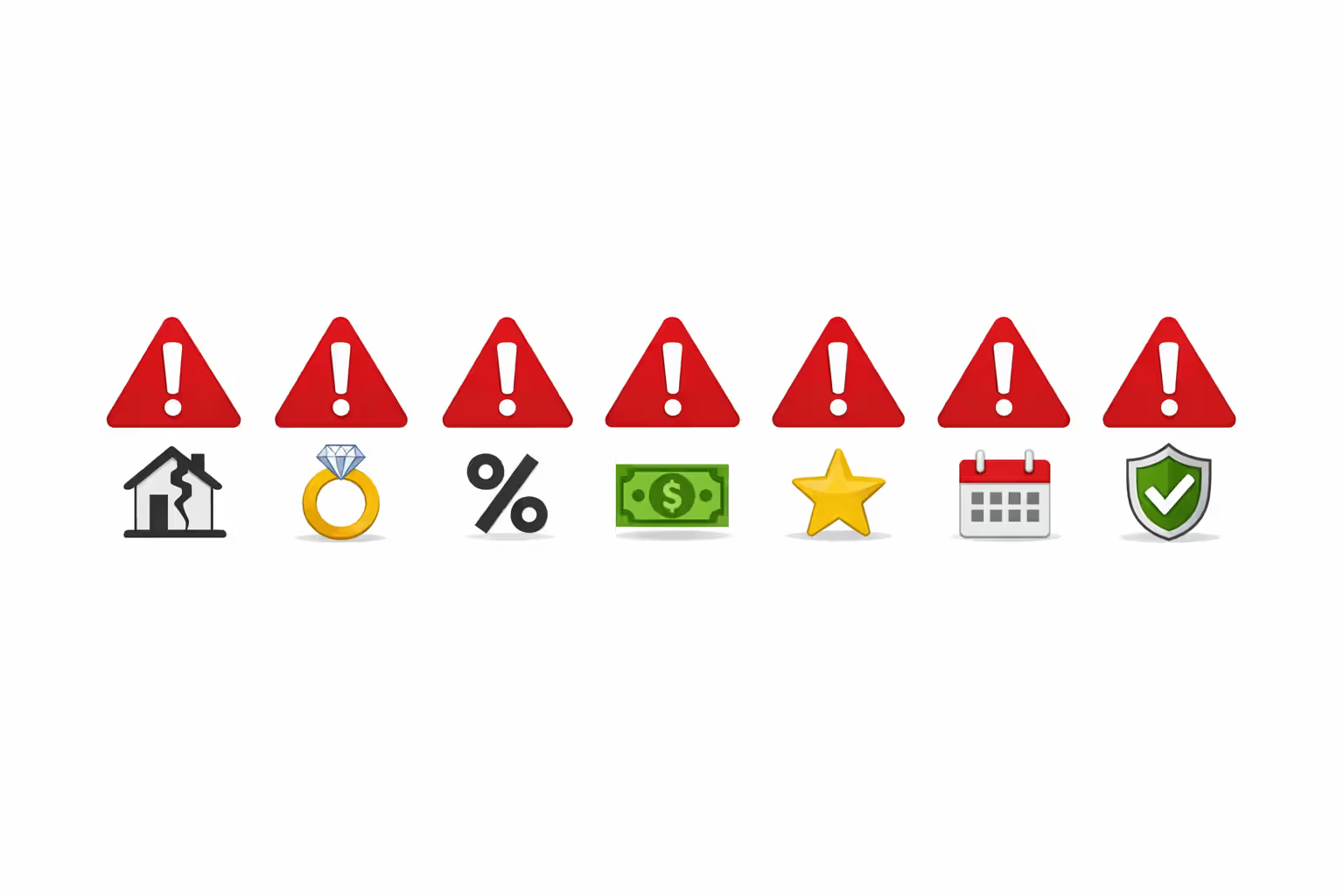
7 Mistakes to Avoid When Shopping for Homeowners Insurance
Following insurance shopping homeowners policy steps guide principles means sidestepping common errors that leave homeowners underprotected or overpaying.
Underinsuring your dwelling: Using market value instead of replacement cost leaves a gap. After a total loss, your $280,000 policy won't rebuild a home that costs $340,000 to construct, even if you only paid $280,000 to buy it.
Ignoring endorsements and riders: Standard policies cap coverage for jewelry at $1,500, firearms at $2,500, and business equipment at $2,500. They typically exclude flood damage, earthquake damage, and sewer backup. If you own a $5,000 engagement ring, run a side business with $10,000 in equipment, or live where basements flood, you need additional coverage.
Not asking about available discounts: Insurers offer discounts for bundling policies, installing monitored security or fire alarms, being claims-free for 3-5 years, having a new roof, upgrading electrical or plumbing, being a non-smoker, or being over 55. These stack—mentioning your new roof, monitored alarm, and auto policy bundle might cut premiums by 30%.
Choosing solely on price: A policy costing $400 less annually might have a $5,000 deductible instead of $1,000, actual cash value instead of replacement cost for belongings, or $100,000 liability instead of $300,000. One claim erases years of premium savings if coverage falls short.
Overlooking company ratings and reviews: Premium costs matter little if the insurer disputes claims, delays payments, or provides poor customer service. Check financial strength ratings from AM Best (A- or better preferred) and customer satisfaction scores from J.D. Power or Consumer Reports. State insurance department websites list complaint ratios.
Not reviewing coverage annually: Home values, construction costs, and personal property accumulate change over time. A policy adequate three years ago may now underinsure your dwelling by 15% or fail to cover the home office equipment you've added. Review coverage when you renovate, make major purchases, or experience significant life changes.
Inadequate liability coverage: The difference in premium between $100,000 and $300,000 liability coverage is often just $50-$75 annually, but the protection gap is enormous. If you have significant assets or income, consider umbrella liability policies that add $1-5 million in coverage for $200-$400 per year.
Author: Samantha Kessler;
Source: sixth-fleet.com
Questions to Ask Insurance Providers Before Buying
Clarifying details before purchasing prevents surprises when you need coverage most. Ask these questions regardless of whether you're working with an agent or buying direct.
What's your claims process, and how quickly do you typically respond? Understanding whether you file claims online, by phone, or through an app matters during stressful situations. Ask about average response times for sending adjusters and issuing payments. Some insurers pride themselves on same-day adjuster visits; others take a week.
Which discounts am I eligible for, and are they already applied? Don't assume the quote includes all possible discounts. Specifically mention security systems, storm shutters, impact-resistant roofing, recent updates, professional affiliations, and claims-free history.
What specific exclusions apply to this policy? Every policy excludes certain perils or scenarios. Common exclusions include flood, earthquake, normal wear and tear, pest damage, and certain types of water damage. Knowing exclusions upfront lets you purchase additional coverage where needed.
What payment options do you offer, and are there fees? Some insurers charge $5-$8 per month for monthly payments instead of annual lump sums. Others offer automatic bank draft discounts. Clarify whether you can adjust payment schedules if needed.
How does this policy cover specific risks relevant to my property? If you have a swimming pool, trampoline, home business, short-term rental activity, or certain dog breeds, ask explicitly how the policy addresses these. Some insurers exclude coverage for specific breeds; others require liability endorsements for pools or trampolines.
What happens if I need to file a claim shortly after purchasing? Verify there are no waiting periods for coverage to take effect. Most policies activate on your specified start date, but some endorsements or specific coverages may have waiting periods.
Can I adjust coverage limits mid-policy if I renovate or make major purchases? Understanding the process for increasing coverage helps you protect new additions to your home without waiting until renewal.

Author: Samantha Kessler;
Source: sixth-fleet.com
How to Finalize Your Homeowners Insurance Purchase
Once you've compared homeowners insurance quote comparison tips guide recommendations and selected a policy, careful review before finalizing prevents costly oversights.
Reviewing Your Policy Documents
Read the declarations page thoroughly—this summary lists your coverage limits, deductibles, endorsements, and premium. Verify that dwelling coverage matches what you discussed, personal property limits are adequate, liability coverage meets your needs, and all endorsements you requested appear.
Check the policy effective date, especially if you're timing coverage to close on a home purchase. Lenders require proof of insurance before closing; coordinate with your agent to ensure documents arrive with enough time for lender review.
Review the full policy document, not just the declarations page. The policy explains what's covered, what's excluded, your responsibilities, and the claims process. Pay attention to maintenance requirements—some policies deny claims if you failed to maintain your roof, heating system, or plumbing adequately.
Confirm that named insureds include all relevant parties. If you co-own the home with a spouse or partner, both names should appear. If you have a mortgage, the lender should be listed as a mortgagee.
Setting Up Payment and Coverage Start Date
Choose a payment method that fits your budget. Annual lump-sum payments often cost less overall but require significant upfront cash. Monthly payments spread costs but may include processing fees that add $60-$100 to your annual cost.
Set up automatic payments if available, reducing the risk of missed payments that could lapse your coverage. However, monitor your bank account to ensure drafts process correctly and amounts match expectations.
Coordinate your coverage start date with your closing date if purchasing a home. Coverage should begin the moment you take ownership. If you're switching insurers on an existing home, avoid gaps by starting new coverage before canceling your old policy, then requesting a refund for the overlap period.
Request proof of insurance documents immediately. Your lender needs these for closing, and you should keep copies for your records. Most insurers email proof of insurance within hours; paper copies arrive within days.
Frequently Asked Questions
Protecting Your Home Starts With Smart Shopping
The effort you invest in thoroughly comparing policies and understanding coverage details pays dividends for years. Homeowners insurance protects one of your largest assets, and the difference between adequate coverage and a policy that leaves you financially exposed often costs less than $50 per month.
Start by calculating accurate replacement costs and inventorying your belongings. Request quotes from multiple sources, comparing coverage components rather than just premiums. Ask specific questions about claims processes, exclusions, and discounts. Review policy documents carefully before finalizing your purchase.
Remember that the cheapest policy rarely provides the best value, and coverage needs change as your home and life evolve. Schedule an annual review to ensure your policy keeps pace with construction costs, home improvements, and accumulated belongings. Smart shopping isn't a one-time task—it's an ongoing process that keeps your most valuable asset properly protected.