Suburban house with insurance policy documents, calculator, and house keys on a table — homeowners insurance concept
How to Choose Homeowners Insurance — Comparing Policies, Coverage, Costs

Content
Picking the wrong homeowners insurance policy can leave you financially exposed when disaster strikes—or paying thousands more than necessary for coverage you don't need. Most homeowners spend less time selecting their policy than they do choosing a new refrigerator, yet this single decision protects what's likely their largest asset.
The right approach balances adequate protection with reasonable premiums while matching coverage to your specific risks. This guide walks through the exact criteria, comparisons, and calculations you need to make an informed choice.
Understanding What Homeowners Insurance Actually Covers
Before comparing policies, you need to know what you're actually buying. Homeowners insurance isn't a single product—it's a bundle of different coverages working together.
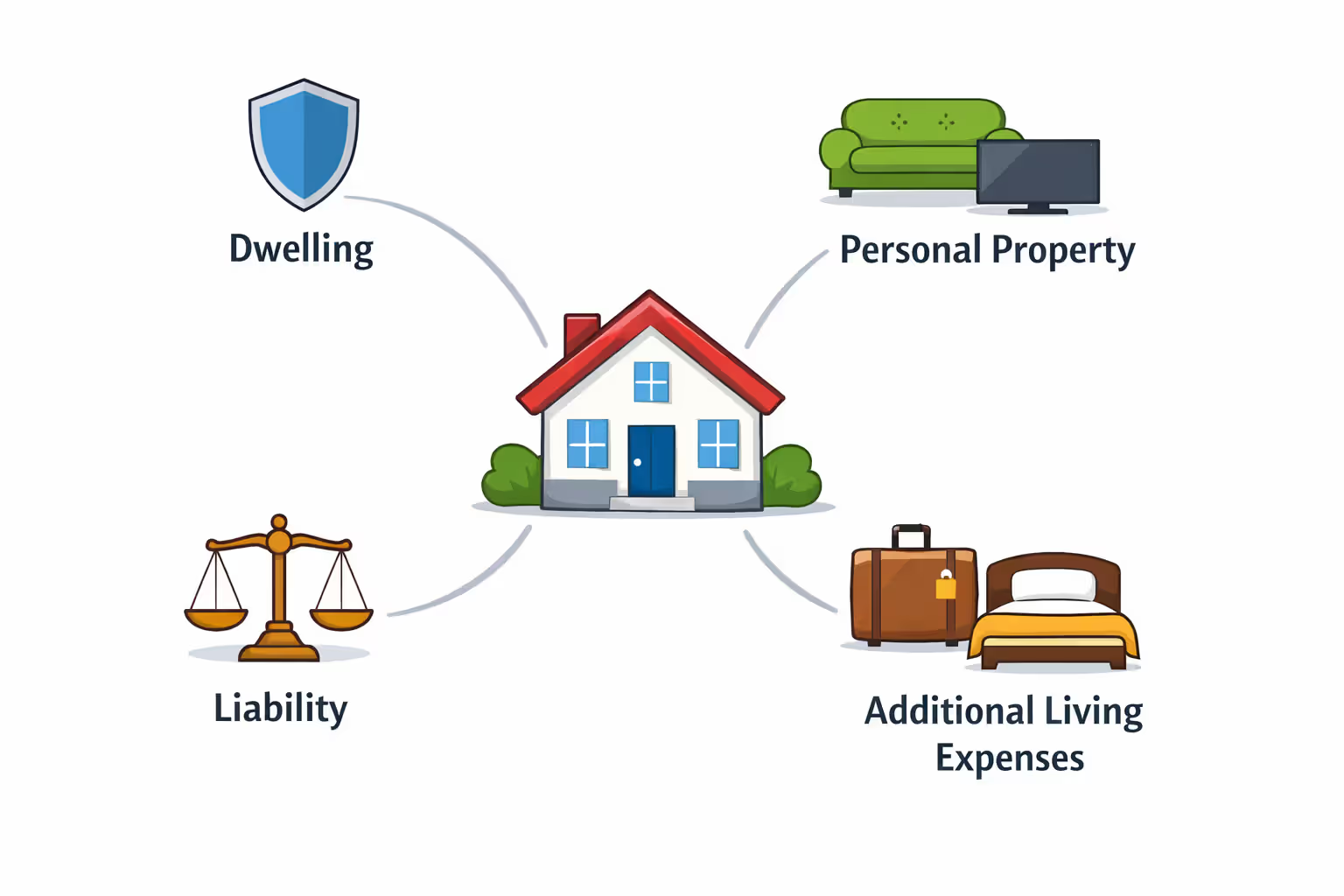
Standard coverage types explained (dwelling, personal property, liability, additional living expenses)
Dwelling coverage pays to repair or rebuild your house after covered damage like fire, windstorms, or vandalism. This is the foundation of your policy and typically the largest coverage amount. It covers the structure itself—walls, roof, built-in appliances, attached garage—but not the land underneath.
Personal property coverage protects your belongings: furniture, clothing, electronics, and other possessions. Standard policies usually cover personal property at 50-70% of your dwelling coverage amount. If your home is insured for $300,000, you'd typically have $150,000-$210,000 in personal property protection. This coverage follows your belongings even when they're outside your home—your laptop stolen from your car or luggage lost during travel may be covered.
Liability coverage protects you when someone gets injured on your property or you accidentally damage someone else's property. If a guest slips on your icy walkway and sues for medical bills and lost wages, liability coverage handles legal defense and any settlement or judgment up to your policy limit. Most policies start at $100,000, but many homeowners need significantly more.
Additional living expenses (ALE) covers your costs if damage makes your home temporarily uninhabitable. This includes hotel bills, restaurant meals (above your normal food costs), and other expenses while your home is being repaired. Coverage typically lasts 12-24 months and is capped at 20-30% of your dwelling coverage.
Most policies also include a small amount of medical payments coverage (usually $1,000-$5,000) that pays for minor injuries to guests regardless of fault—no lawsuit required.
Author: Samantha Kessler;
Source: sixth-fleet.com
What's typically excluded from basic policies
Standard homeowners insurance doesn't cover everything. Flood damage requires separate flood insurance through the National Flood Insurance Program or private insurers. This catches many homeowners off-guard—even heavy rain causing basement flooding isn't covered under standard policies.
Earthquake damage also requires a separate policy or endorsement in most states. Sewer backup is excluded unless you add specific coverage. Normal wear and tear, maintenance issues, and gradual deterioration aren't covered—insurance pays for sudden, accidental damage, not deferred maintenance.
Most policies limit coverage for certain valuable items. Jewelry, watches, and furs might be capped at $1,000-$2,500 total. Collectibles, artwork, and business property often have similar sub-limits. You'll need scheduled personal property endorsements or floaters for valuable items.
Intentional damage, neglect, and certain dog breeds may be excluded or limited. Some insurers won't cover homes with certain roof types, knob-and-tube wiring, or other characteristics they consider high-risk.
7 Essential Criteria for Evaluating Homeowners Insurance Providers
Choosing homeowners insurance means selecting both a policy and a company. The cheapest premium means nothing if the insurer drags out claims or becomes insolvent. These homeowners insurance selection criteria guide your evaluation of potential providers.

Author: Samantha Kessler;
Source: sixth-fleet.com
Financial strength ratings indicate whether an insurer can pay claims even after catastrophic events. Check ratings from A.M. Best, Moody's, or Standard & Poor's. Look for ratings of A or better. A financially weak insurer might offer attractive rates but could struggle to pay claims after a major hurricane or wildfire season.
Complaint ratios reveal how often customers have problems serious enough to file complaints with state regulators. The National Association of Insurance Commissioners publishes complaint indexes comparing insurers. A ratio above 1.0 means the company generates more complaints than expected for its market share. Ratios below 0.5 indicate fewer complaints than average.
Claims processing reputation matters most when you actually need your insurance. Research how quickly companies settle claims and their approval rates. J.D. Power's claims satisfaction studies provide useful data. Talk to friends and neighbors about their claims experiences. Some insurers are known for fast, fair settlements; others routinely lowball initial offers or delay payments.
Customer service accessibility includes how easily you can reach someone when you need help. Can you get a live person on the phone within reasonable wait times? Are service hours convenient? Some companies offer 24/7 support; others keep banker's hours. Check whether they offer multiple contact channels—phone, email, chat, mobile app.
Local agent availability provides a trade-off. Captive agents working for a single company offer personalized service and local expertise but represent only one insurer's products. Independent agents represent multiple companies, making comparison shopping easier, but may have less specialized knowledge. Direct-to-consumer insurers eliminate agents entirely, often reducing costs but also reducing personalized guidance. Choose based on how much hand-holding you want.
Digital tools increasingly matter for policy management. Quality insurers offer apps or websites where you can view your policy, file claims, update coverage, access ID cards, and make payments. The best platforms let you upload photos and documents directly when filing claims, speeding the process significantly.
Discount programs can substantially reduce premiums. Common discounts include bundling home and auto insurance (often 15-25% savings), installing security systems (5-20%), having a newer roof (10-15%), being claims-free for several years (up to 20%), and being a non-smoker. Some insurers offer discounts for professional affiliations, military service, or simply for shopping early before your current policy expires.
The biggest mistake homeowners make is shopping on price alone. The difference between a $900 annual premium and a $1,200 premium disappears instantly if you're underinsured by $100,000 when you need to rebuild. Focus first on adequate coverage from a financially sound company, then optimize price
— Amy Bach
How to Compare Homeowners Insurance Policies Side-by-Side
Evaluating homeowners insurance providers becomes practical when you compare specific policies with identical coverage parameters. Request quotes with the same dwelling coverage, deductible, and liability limits from each insurer—otherwise you're comparing apples to oranges.
This comparing homeowners insurance policies guide requires organizing information systematically. Create a spreadsheet or use the comparison table below as a template.
| Provider | Annual Premium | Dwelling Coverage | Personal Property | Liability | Deductible | Notable Features | Best For |
| Provider A | $1,450 | $350,000 | $262,500 (75%) | $300,000 | $1,000 | Replacement cost coverage; water backup included; 15% multi-policy discount | Homeowners wanting comprehensive protection with low deductible |
| Provider B | $1,180 | $350,000 | $245,000 (70%) | $300,000 | $2,500 | Actual cash value only; sewer backup excluded; claims app with photo upload | Budget-conscious homeowners comfortable with higher deductible |
| Provider C | $1,625 | $350,000 | $262,500 (75%) | $500,000 | $1,000 | Extended replacement cost (125%); identity theft coverage; local agent network | High-value homes in areas with rising construction costs |
| Provider D | $1,295 | $350,000 | $262,500 (75%) | $300,000 | $1,500 | Guaranteed replacement cost; equipment breakdown coverage; smart home discounts | Tech-savvy homeowners with newer homes |
| Provider E | $1,385 | $350,000 | $280,000 (80%) | $300,000 | $1,000 | Inflation guard (2% annual increase); ordinance/law coverage; veteran discounts | Older homes that may need code upgrades when repaired |
When comparing, watch for these differences beyond the premium:
Replacement cost vs. actual cash value for personal property makes a huge difference. Replacement cost pays to buy new items; actual cash value deducts depreciation. A five-year-old laptop might cost $1,200 to replace but have an actual cash value of $400.
Extended or guaranteed replacement cost coverage pays more than your dwelling limit if construction costs have increased. Extended replacement cost typically adds 25-50% more coverage; guaranteed replacement cost has no cap (though some insurers have discontinued this due to rising costs).
Special limits and sublimits vary by insurer. One company might cap jewelry at $2,500 while another offers $5,000. These details hide in the fine print but matter when you file a claim.
Deductible options affect both premiums and out-of-pocket costs. A $2,500 deductible might save you $400 annually compared to a $1,000 deductible—but you'll pay $1,500 more out-of-pocket for each claim. Choose based on your emergency fund and risk tolerance.
Determining the Right Coverage Amounts for Your Home
Getting coverage amounts right prevents both overpaying for unnecessary coverage and devastating gaps when you need to rebuild.
Calculating replacement cost vs. market value
Your home's market value—what you could sell it for—is irrelevant for insurance purposes. You can't sell a pile of ashes after a fire. What matters is replacement cost: how much it would cost to rebuild your home from the ground up using similar materials and quality.
Replacement cost often differs significantly from market value. In expensive urban markets, land drives prices—your $800,000 home might only cost $350,000 to rebuild. In markets where construction costs are high relative to home prices, the opposite occurs: your $250,000 home might cost $320,000 to rebuild.
To estimate replacement cost, use your insurer's calculator or hire a professional appraiser. These tools consider your home's square footage, construction quality, special features (custom cabinets, high-end finishes), and local construction costs. Don't simply use the price you paid for your home or its current market value.
Construction costs fluctuate. Lumber prices can double during shortages. Labor costs rise in areas experiencing building booms. Many insurers offer inflation guard endorsements that automatically increase your coverage by a small percentage annually to keep pace with construction cost inflation.

Author: Samantha Kessler;
Source: sixth-fleet.com
Consider ordinance and law coverage, which pays the additional cost to bring your rebuilt home up to current building codes. If your 1960s home doesn't meet current electrical or seismic codes, rebuilding might require expensive upgrades not covered by standard dwelling coverage.
How much liability coverage you actually need
The standard $100,000 liability coverage is inadequate for most homeowners. If someone suffers serious injuries on your property and sues for $500,000, you're personally liable for the $400,000 not covered by insurance.
A reasonable rule of thumb: carry liability coverage equal to your net worth. If you have $400,000 in home equity, retirement accounts, and other assets, carry at least $400,000 in liability coverage. Without adequate coverage, a lawsuit could force you to liquidate assets or garnish future wages.
Increasing liability from $100,000 to $300,000 typically costs only $30-$75 annually—a small price for substantial additional protection. Jumping to $500,000 might add another $40-$60.
For homeowners with significant assets, a personal umbrella policy provides an additional $1-$5 million in liability coverage above your home and auto policies, typically for $200-$400 annually per million in coverage. This is the most cost-effective way to protect substantial wealth.
Common Mistakes That Cost Homeowners Thousands
Even when following homeowners insurance comparison tips, these errors create expensive problems.
Underinsuring dwelling coverage is the most expensive mistake. Many homeowners insure for their purchase price or current market value rather than replacement cost. When construction costs have risen 30% since you bought your home five years ago, that $300,000 coverage might leave you $90,000 short of actual rebuilding costs. Review replacement cost estimates every 2-3 years and after major renovations.
Choosing high deductibles solely to reduce premiums backfires if you can't afford the deductible when you need to file a claim. A $5,000 deductible might save you $600 annually, but if you can't come up with $5,000 after a kitchen fire, you're stuck. Match deductibles to your emergency fund, not just your premium budget.
Ignoring endorsements for specific risks leaves gaps. If you live in an area with aging sewer systems, skipping water backup coverage to save $40 annually seems foolish when a backup causes $15,000 in basement damage. Evaluate endorsements for sewer backup, equipment breakdown, identity theft, and scheduled personal property based on your actual risks.
Not updating coverage after renovations creates underinsurance. That $80,000 kitchen remodel increased your replacement cost, but your coverage stays the same unless you notify your insurer. Some policies include automatic increases, but major renovations require manual updates.
Assuming flood or earthquake coverage is included leads to nasty surprises. These perils require separate policies or endorsements. Even if you're not in a mapped flood zone, heavy rains can cause flooding. Review whether you need this coverage based on your location and risk tolerance.
Dropping coverage during financial hardship leaves you exposed when you can least afford it. If you must reduce insurance costs, increase deductibles or remove optional endorsements rather than dropping coverage entirely or reducing dwelling coverage below replacement cost.
Not documenting possessions before a loss makes claims difficult. Create a home inventory with photos or video of your belongings, including model numbers and receipts for valuable items. Store this documentation outside your home (cloud storage works well). After a total loss, trying to remember and prove everything you owned is nearly impossible.

Author: Samantha Kessler;
Source: sixth-fleet.com
Getting Accurate Quotes and Finalizing Your Decision
The quote process reveals as much about an insurer as the final price.
Gather information before requesting quotes: your home's age, square footage, construction type (frame, brick, etc.), roof age and material, heating/cooling systems, electrical panel type, and any upgrades or special features. You'll also need information about your claims history, current insurance, and credit history (in most states).
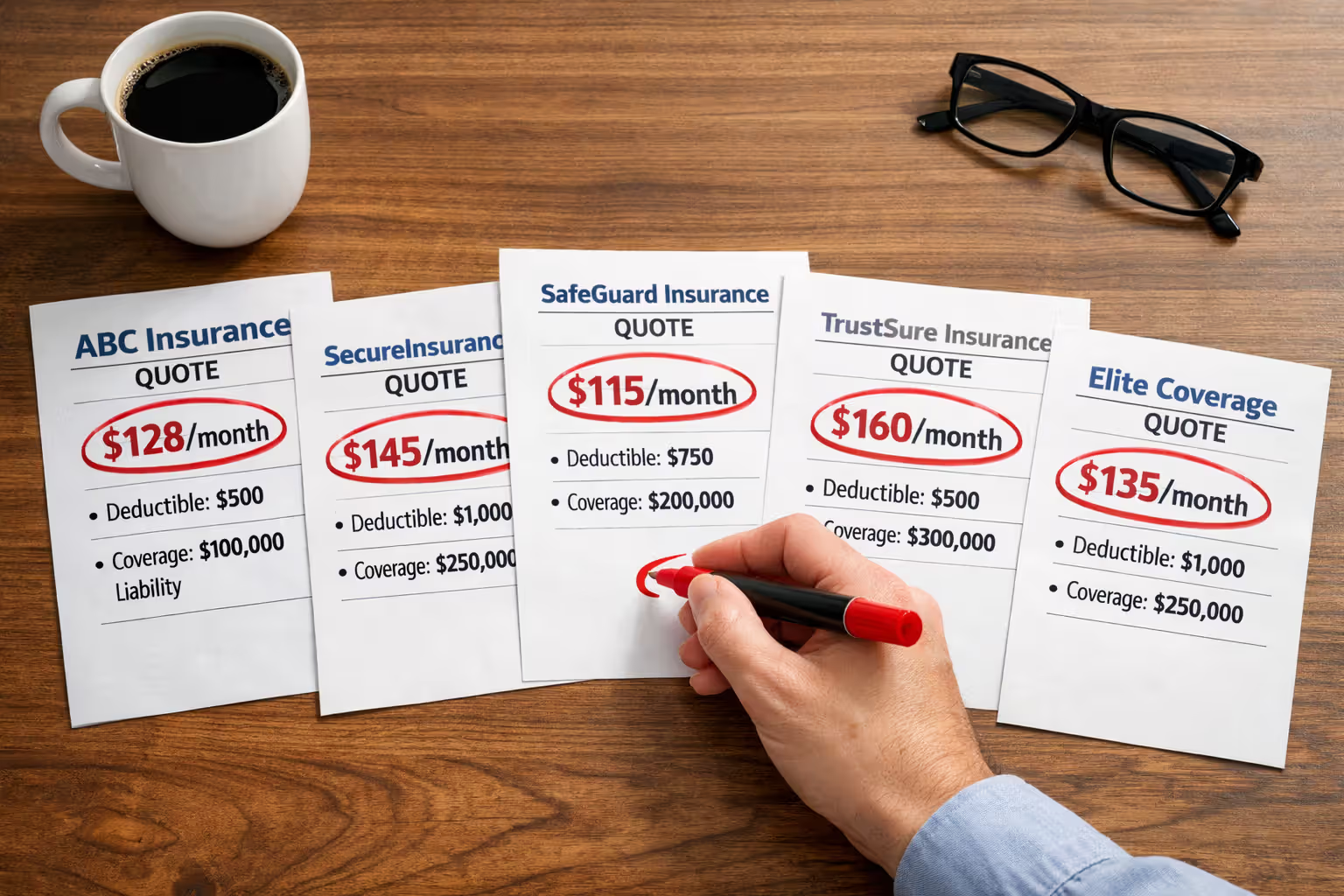
Request quotes from at least 3-5 insurers representing different business models: a national direct writer, a regional insurer, an independent agent representing multiple companies, and perhaps a company specializing in your state or region. This range gives you perspective on market pricing and coverage options.
Provide identical information to each insurer—same coverage amounts, deductibles, and property details. Otherwise, you're not making valid comparisons.
Red flags during the quote process include:
- Agents who pressure you to decide immediately or claim their "special pricing" expires today
- Quotes significantly lower than competitors without clear explanations (often indicates less coverage or higher deductibles)
- Companies unwilling to provide written quotes or detailed coverage summaries
- Agents who discourage questions or rush through coverage explanations
- Insurers requiring large upfront payments before providing policy details
Negotiating opportunities are limited with homeowners insurance since rates are filed with state regulators, but you can often negotiate on discounts. Ask about every available discount: bundling, security systems, claims-free history, professional affiliations, military service, age of home, roof upgrades, and more. Some discounts require asking specifically.
Before finalizing, read the actual policy declarations page and coverage forms, not just the quote summary. Verify dwelling coverage, deductibles, liability limits, and any endorsements match what you discussed. Check for unexpected exclusions or limitations.
Ask about payment options. Paying annually often saves 5-10% compared to monthly installments. Some insurers offer additional discounts for automatic payments or paperless billing.
Finally, confirm the cancellation process for your current policy. Most policies require 30 days' notice. Time your new policy's start date to avoid coverage gaps or paying for overlapping policies.
Author: Samantha Kessler;
Source: sixth-fleet.com
Frequently Asked Questions About Choosing Homeowners Insurance
Making Your Choice With Confidence
Selecting homeowners insurance requires balancing protection, price, and provider reliability. Start by understanding exactly what coverage you need based on your home's replacement cost and your liability exposure—not what's cheapest or what your neighbor bought. Evaluate insurers on financial strength and service quality before comparing prices. Use side-by-side policy comparisons with identical coverage parameters to identify the best value.
Avoid the expensive mistakes that plague many homeowners: underinsuring dwelling coverage, skipping essential endorsements, or choosing deductibles you can't afford. Document your possessions now, review coverage after renovations, and reassess your policy annually as construction costs and your financial situation evolve.
The few hours you invest in this process protect decades of homeownership. Your policy should provide genuine peace of mind, knowing you're adequately protected at a fair price from a company that will be there when disaster strikes.