
Suburban house with red roof next to open insurance policy document calculator and stack of dollar bills on green lawn aerial view
How Much Homeowners Insurance Do I Need Based on My Home’s Value

Content
Determining the right amount of homeowners insurance isn't as simple as picking a number from a dropdown menu. Most homeowners either overpay for coverage they'll never use or—more dangerously—leave themselves exposed to financial catastrophe by underinsuring their property.
The difference between adequate and inadequate coverage often becomes painfully clear only after a disaster strikes. A family in Colorado discovered their $300,000 policy fell $120,000 short of rebuilding costs after a wildfire destroyed their home. The insurance company paid their maximum limit, but the homeowners had to drain retirement savings and take a second mortgage to complete reconstruction.
Understanding how much homeowners insurance you actually need requires looking beyond simple formulas and considering your specific situation, assets, and risks.

Author: Marcus Hollowell;
Source: sixth-fleet.com
Why Standard Coverage Formulas Often Fall Short
Insurance agents frequently recommend the 80% rule: insure your home for at least 80% of its replacement cost to avoid coinsurance penalties. While this industry standard prevents the most severe underinsurance, it creates a false sense of security.
The 80% threshold represents the minimum needed to avoid penalty clauses, not the amount required to fully rebuild your home. If your house would cost $400,000 to rebuild and you insure it for $320,000 (80%), you're still $80,000 short if total loss occurs.
Market-based formulas fail even more dramatically. Some homeowners simply insure their property for the purchase price or current market value. A home purchased for $350,000 in a desirable neighborhood might sit on land worth $150,000, meaning the actual structure would cost only $200,000 to rebuild. Conversely, a modest home in an expensive urban area might have a $500,000 market value but require $450,000 to reconstruct—the land contributes little to replacement cost.
Calculating homeowners insurance coverage needs demands a more granular approach than applying blanket percentages. Regional construction costs vary wildly. Rebuilding an identical 2,000-square-foot home costs roughly $250,000 in Houston, $350,000 in Denver, and $500,000 in San Francisco. Standard formulas ignore these geographic realities.
The Four Coverage Types That Determine Your Total Policy Amount
Your total insurance coverage isn't a single number. Homeowners policies divide protection into distinct categories, each serving a specific purpose.
Dwelling Coverage (Structure Replacement)
Dwelling coverage pays to rebuild your home's structure—walls, roof, built-in appliances, attached garage, and permanently installed fixtures. This represents your policy's largest component and the foundation for calculating other coverage amounts.
Most insurers offer dwelling coverage in increments of $10,000 or $25,000. You'll typically see options ranging from $150,000 to $1,000,000+ depending on your home's characteristics. Extended replacement cost endorsements add 25-50% above your stated limit, protecting against construction cost spikes after widespread disasters when contractor demand surges.
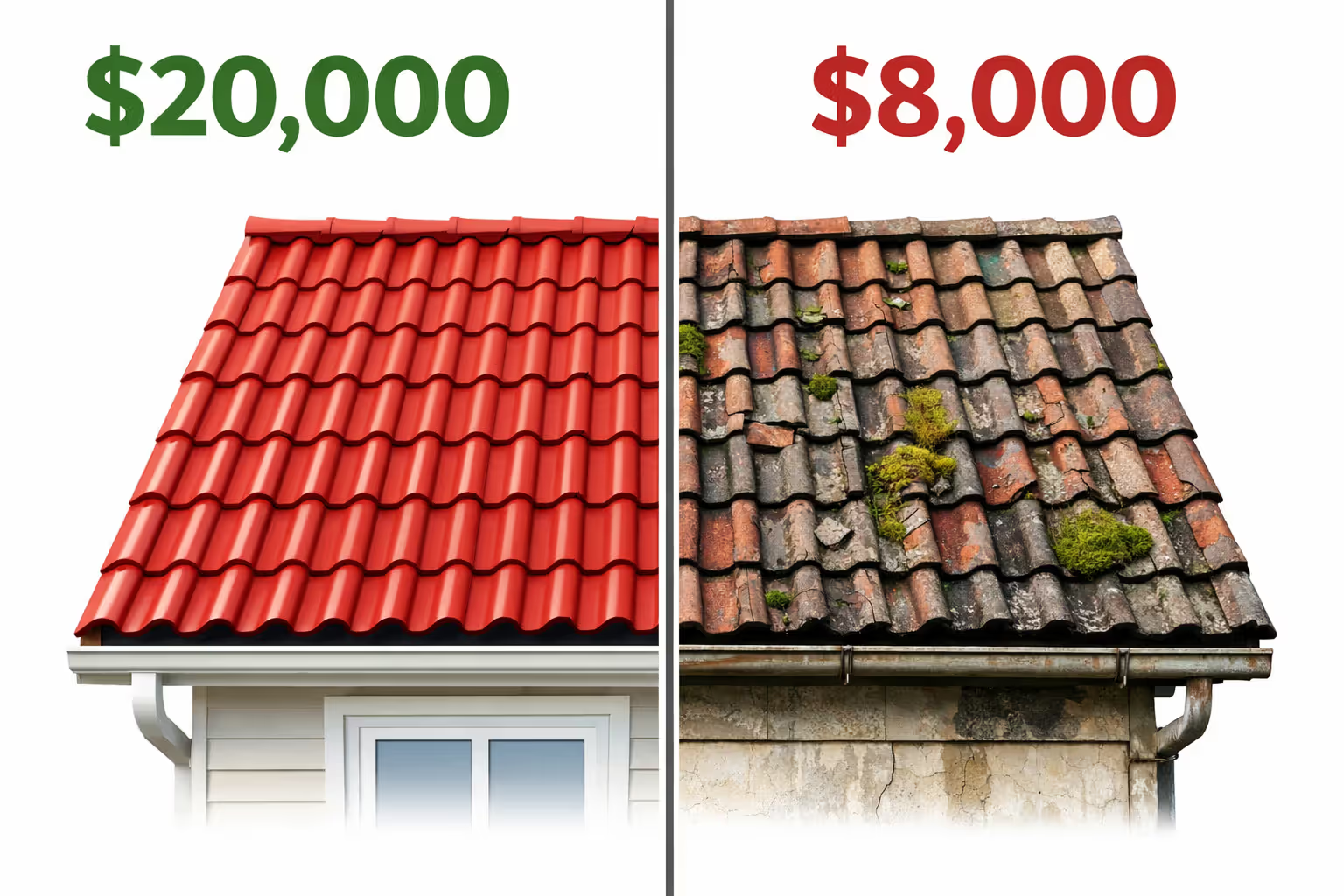
Replacement cost differs fundamentally from actual cash value. Replacement cost rebuilds your home with similar materials at today's prices. Actual cash value subtracts depreciation, leaving you with far less money. A 15-year-old roof might cost $20,000 to replace but have an actual cash value of only $8,000 after depreciation.
Author: Marcus Hollowell;
Source: sixth-fleet.com
Personal Property Protection
Personal property coverage protects your belongings—furniture, clothing, electronics, appliances, and other movable items. Standard policies typically provide personal property coverage equal to 50-70% of dwelling coverage.
For a home with $300,000 dwelling coverage, you'd receive $150,000-$210,000 for personal property. This percentage-based approach works reasonably well for average households but fails for people with expensive collections, high-end electronics, or valuable jewelry.
Basic policies cap individual item categories. Jewelry might have a $1,500 sublimit, firearms $2,500, and cash $200. Homeowners with property exceeding these thresholds need scheduled personal property endorsements listing specific high-value items with agreed-upon values.
Liability Coverage Limits
Liability coverage protects your assets if someone sues you for injuries or property damage. Standard policies offer $100,000-$500,000 in liability protection, but these amounts often prove inadequate for homeowners with significant assets.
Financial advisors generally recommend liability coverage equal to your net worth. Someone with $750,000 in home equity, retirement accounts, and other assets needs at least $750,000 in liability protection—preferably $1,000,000. Without adequate coverage, plaintiffs can pursue your personal assets beyond policy limits.
A guest who trips on your front steps and suffers a severe back injury might sue for $400,000 in medical bills, lost wages, and pain and suffering. If your policy maxes out at $300,000, you're personally liable for the remaining $100,000 plus your legal defense costs.
Additional Living Expenses (ALE)
Additional living expenses cover hotel bills, restaurant meals, and other costs if your home becomes uninhabitable during repairs. Standard policies provide ALE equal to 20-30% of dwelling coverage for up to 12-24 months.
A home with $400,000 dwelling coverage typically includes $80,000-$120,000 in ALE. This sounds generous until you calculate actual displacement costs. A family spending $200/night on hotels plus $100/day on meals burns through $9,000 monthly. Major reconstruction projects easily stretch 8-12 months, consuming $72,000-$108,000.
Homeowners in high-cost areas or those with large families should consider increasing ALE limits beyond standard percentages.
Step-by-Step: Calculating Your Required Homeowners Insurance Coverage Amount
Accurate coverage estimation requires methodical evaluation of multiple factors rather than guesswork.
Step 1: Determine true replacement cost. Ignore your home's market value and purchase price. Instead, estimate what rebuilding would cost today using local construction rates. Multiply your home's square footage by local per-square-foot construction costs, then add premiums for custom features.
A 2,500-square-foot home in an area with $150/square-foot construction costs needs roughly $375,000 base coverage. Add $25,000 for custom tile work, $15,000 for upgraded fixtures, and $10,000 for a specialty roof, bringing total dwelling coverage to $425,000.
Step 2: Inventory your belongings. Walk through your home room by room, documenting items and estimating replacement costs. Most people dramatically underestimate personal property values until they actually count everything.
A typical master bedroom contains $15,000-$25,000 in furniture, clothing, and electronics. Multiply this across all rooms, plus garage tools, outdoor equipment, and storage areas. Many households discover they own $100,000-$200,000 in personal property.
Step 3: Evaluate liability exposure. Calculate your total net worth including home equity, retirement accounts, investment accounts, and other assets. Your liability coverage should match or exceed this amount.
Consider risk factors that increase lawsuit probability: swimming pools, trampolines, dogs (especially certain breeds), home businesses, or frequent entertaining. These exposures warrant higher liability limits or umbrella policies providing $1,000,000-$5,000,000 in additional coverage.
Step 4: Research local rebuilding costs. Contact local contractors for rough per-square-foot estimates. Building departments often publish average construction costs for permit applications. Online tools provide starting points but require adjustment for local conditions.
Post-disaster construction costs spike dramatically. After Hurricane Katrina, Louisiana rebuilding costs jumped 40% due to contractor shortages and material scarcity. Guaranteed replacement cost policies eliminate this risk by paying full reconstruction costs regardless of policy limits.
Comparison of Calculation Methods
| Method | Description | Accuracy | Cost | Time Required | Best For |
| Square Footage Method | Multiply home's square footage by local per-square-foot construction cost | Moderate—misses custom features and finishes | Free | 15-30 minutes | Standard homes with few custom features |
| Professional Appraisal | Licensed appraiser evaluates property and provides detailed replacement cost estimate | High—accounts for all features, materials, and local factors | $300-$600 | 1-2 weeks | Custom homes, historic properties, high-value residences |
| Online Estimator Tools | Insurance company or third-party calculators using property data and algorithms | Moderate to High—depends on data quality and algorithm sophistication | Free to $50 | 10-20 minutes | Most homeowners seeking quick, reasonably accurate estimates |
7 Factors That Change Your Insurance Coverage Calculation
Generic formulas ignore critical variables that dramatically impact required coverage amounts.
Local building costs: Construction expenses vary by 200-300% between markets. San Francisco's $500/square-foot costs dwarf Detroit's $150/square-foot rates. Use local data, not national averages.
Home age and features: Older homes with plaster walls, hardwood floors, or custom millwork cost significantly more to rebuild than modern tract homes. A 1920s Craftsman requires specialty contractors familiar with period-appropriate techniques and materials.
Natural disaster zones: Homes in wildfire, hurricane, or earthquake zones need higher coverage limits and special endorsements. Coastal properties require separate wind/hail policies or substantial additional premiums.
Personal assets: Higher net worth demands proportionally higher liability coverage. Someone with $2,000,000 in assets needs $2,000,000+ in liability protection, often requiring umbrella policies beyond standard homeowners coverage.

Author: Marcus Hollowell;
Source: sixth-fleet.com
Mortgage requirements: Lenders mandate coverage equal to the loan amount or replacement cost, whichever is less. A $350,000 mortgage requires at least $350,000 in dwelling coverage regardless of your personal calculation.
Deductible choices: Higher deductibles ($2,500-$5,000) reduce premiums 15-30% but require larger out-of-pocket payments for claims. Balance premium savings against emergency fund capacity.
Endorsements and riders: Scheduled property endorsements for jewelry, art, or collectibles; water backup coverage; equipment breakdown protection—each addition increases total coverage amounts and premiums.
Common Mistakes When Estimating Homeowners Insurance Needs
Even diligent homeowners make predictable errors when calculating coverage requirements.
Confusing market value with replacement cost represents the most frequent miscalculation. Your home's sale price reflects land value, neighborhood desirability, school districts, and market conditions. Replacement cost covers only reconstruction expenses. A $600,000 home on a $200,000 lot needs roughly $400,000 in dwelling coverage, not $600,000.
Underinsuring personal property happens when homeowners accept default coverage percentages without inventorying belongings. The standard 50% personal property allocation provides $150,000 coverage for a $300,000 dwelling policy. Families with $200,000+ in furnishings, electronics, and clothing face significant shortfalls.
Ignoring inflation guard clauses leaves coverage static while construction costs rise. Inflation guard endorsements automatically increase dwelling coverage 3-4% annually, maintaining pace with construction cost inflation. Without this protection, adequate coverage erodes over time.
Skipping liability umbrella consideration exposes high-net-worth homeowners to catastrophic losses. Someone with $1,500,000 in assets and $300,000 in homeowners liability coverage leaves $1,200,000 exposed to lawsuits. A $1,000,000 umbrella policy costs only $300-$500 annually while protecting substantial assets.
The biggest gap I see is homeowners who haven't updated their coverage in 5-10 years. They bought a policy when their home was worth $250,000, and now reconstruction would cost $400,000. They're paying premiums on outdated limits that wouldn't come close to covering a total loss. I recommend formal coverage reviews every three years, minimum
— Sarah Chen
When to Recalculate Your Coverage Limits
Insurance coverage calculation isn't a one-time exercise. Specific triggers demand immediate policy reviews.
Home renovations: Kitchen remodels, bathroom additions, finished basements, or room additions directly increase replacement costs. A $75,000 kitchen renovation should trigger a dwelling coverage increase of roughly $75,000. Notify your insurer before starting projects—some policies require pre-approval for coverage to apply.
Major purchases: Buying expensive jewelry, art collections, musical instruments, or other high-value items requires scheduled property endorsements. Standard sublimits won't adequately protect these purchases.
Market changes: While market value shouldn't determine coverage, significant construction cost inflation warrants review. Lumber prices spiked 300% during 2020-2021, dramatically increasing rebuilding costs. Monitor local construction trends and adjust coverage accordingly.
Policy renewal periods: Annual renewals provide natural review opportunities. Request updated replacement cost estimates from your insurer. Many companies now use sophisticated algorithms incorporating current material and labor costs.
Life changes also necessitate coverage adjustments. Marriage, divorce, inheritance, business ventures, or retirement often shift asset profiles and liability exposures. Each transition merits policy evaluation.

Author: Marcus Hollowell;
Source: sixth-fleet.com
FAQ: Coverage Estimation for Homeowners Insurance Policies
Protecting Your Investment With Proper Coverage
Determining how much homeowners insurance you need comes down to honest assessment of your property's true replacement cost, your personal assets, and your specific risk factors. The cheapest policy rarely provides adequate protection, but the most expensive option might include coverage you'll never use.
Start with accurate replacement cost calculations using local construction rates, not market values or purchase prices. Inventory your belongings to verify personal property coverage matches reality. Set liability limits equal to or exceeding your net worth, adding umbrella coverage for substantial assets. Review and adjust coverage every few years, immediately after renovations, and whenever life changes affect your financial situation.
The goal isn't maximum coverage—it's appropriate coverage that fully protects your home and assets without paying for unnecessary protection. A methodical approach to calculating your needs delivers that balance, providing genuine peace of mind that you're neither overpaying nor dangerously exposed.