
Homeowners insurance declaration page document on a wooden desk with pen, glasses, and house keys
What Is a Homeowners Insurance Declaration Page? A Simple Guide

Content
Your homeowners insurance declaration page is a one- to three-page summary that lists every essential detail about your coverage—who's insured, what's protected, how much you'll pay, and what your policy won't cover. This guide explains how to read it and why it matters.
What Is a Homeowners Insurance Declaration Page? Your Complete Guide to Understanding Your Policy Summary
Your homeowners insurance declaration page is a one- to three-page summary that lists every essential detail about your coverage—who's insured, what's protected, how much you'll pay, and what your policy won't cover. Think of it as the executive summary of a contract that might run 40 to 80 pages. When you receive your policy documents, this page sits at the front because it contains the information you'll reference most often.
Unlike the full policy, which explains coverage conditions in legal language, the declaration page presents facts in a straightforward format: dollar amounts, dates, names, and addresses. Insurance companies generate a new dec page whenever your coverage changes, whether that's adding an endorsement for your home business or increasing your dwelling coverage after a renovation.
Breaking Down Your Homeowners Insurance Declarations Page
The declaration page serves as a legally binding snapshot of your active coverage. It's not a separate document from your policy—it's the first section, and the terms listed here override any conflicting information in the standard policy language that follows.
You'll receive a declaration page in several situations: when you purchase a new policy, at each renewal (typically annual), after making mid-term changes like adding a rider for jewelry, or when your insurance company adjusts your premium. Some insurers mail paper copies, while others provide digital access through customer portals.
The declarations page is your first line of defense in understanding whether your coverage matches your actual needs. Homeowners who review this document annually are far more likely to catch coverage gaps before a loss occurs
— According to the National Association of Insurance Commissioners
Most declaration pages follow a similar layout, though formatting varies by carrier. Property and casualty insurers typically organize information from top to bottom: policyholder details, property information, coverage amounts, premium breakdown, and special conditions. The document uses standardized insurance abbreviations—"BI" for bodily injury, "PD" for property damage, "ACV" for actual cash value—which can confuse first-time homeowners.
State insurance departments require specific information to appear on every declaration page. This includes the policy number (your unique identifier when filing claims or calling customer service), the policy period with exact start and end times (usually 12:01 AM on the effective date), and the name of the licensed insurance company issuing the policy.
12 Critical Items Found on Your Declaration Page
Every homeowners insurance declarations sheet contains standardized elements, though the order and labels differ by company. Here's what you'll find:
Named Insured: The person or people who own the policy. If you're married and both names appear, you're both covered and both responsible for premium payments. Adding or removing a name requires formal documentation—simply getting divorced doesn't automatically remove an ex-spouse from your policy.
Property Address: The physical location of the insured home. This must match your actual residence, not a P.O. box or billing address. If you own multiple properties, each requires a separate policy with its own declaration page.
Policy Number: Your unique identifier, typically 8 to 12 alphanumeric characters. You'll need this for every interaction with your insurer, from filing claims to requesting certificates of insurance.
Policy Period: Start and end dates, including specific times (usually 12:01 AM to 12:01 AM). Coverage gaps happen when homeowners assume their policy renews automatically but miss a payment or fail to respond to renewal notices.
Mortgagee/Lienholder: Your lender's name and address. They're listed as an "additional insured" or "loss payee," meaning claim checks for dwelling damage will include their name. This protects their financial interest in your property.
Agent Information: Your insurance agent or broker's contact details. This is who you'll call for policy changes, coverage questions, or claim assistance.
Coverage Limits Explained
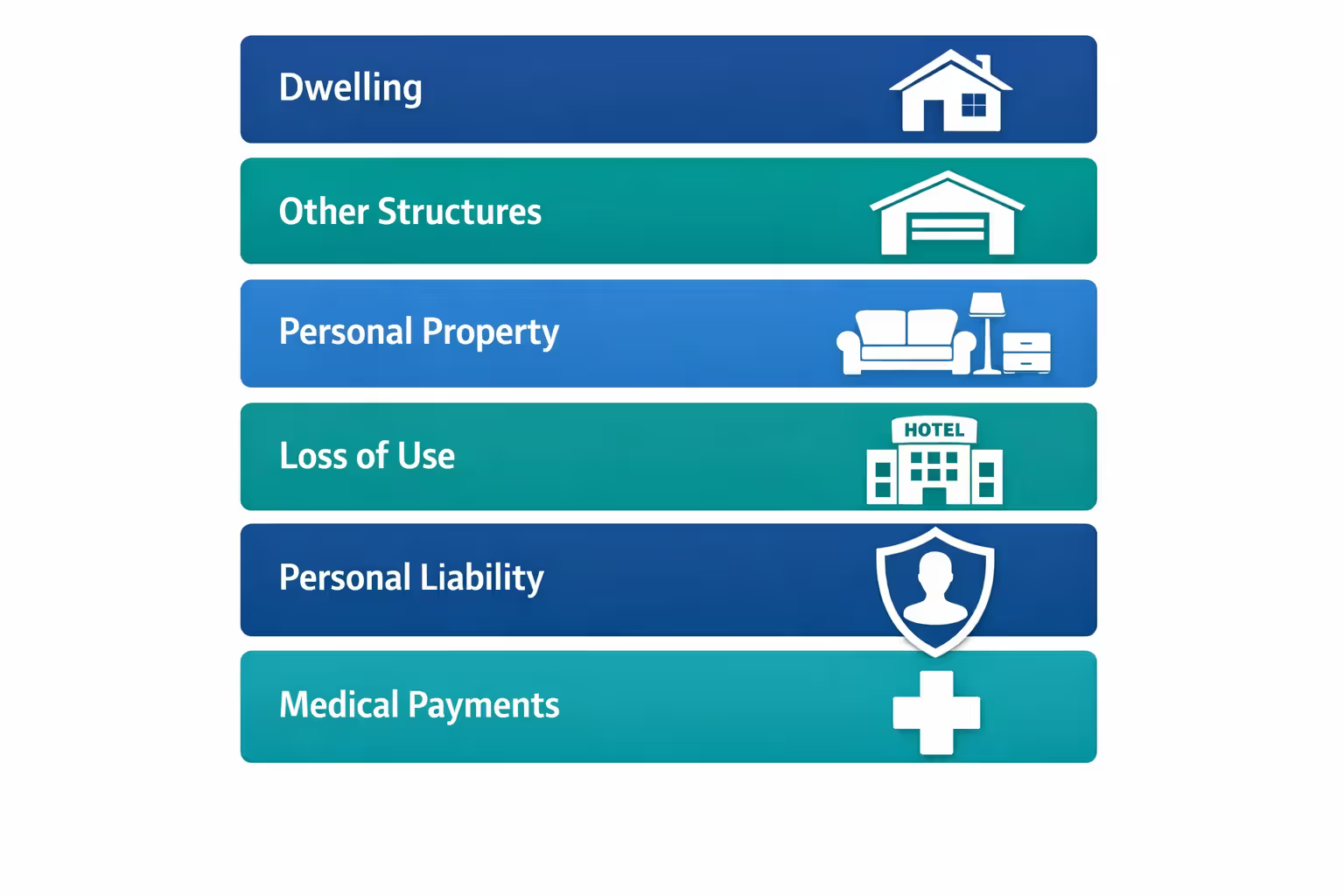
The declaration page lists six standard coverage sections (Coverage A through F for most HO-3 policies):
Coverage A (Dwelling): The maximum amount your insurer will pay to rebuild your home. This should reflect replacement cost, not market value. A $400,000 home in a hot real estate market might only cost $250,000 to rebuild—that lower number is what matters here.
Coverage B (Other Structures): Typically 10% of Coverage A, this protects detached garages, sheds, fences, and similar structures. A detached garage converted into a rental unit needs higher limits and possibly a separate policy.
Coverage C (Personal Property): Usually 50-70% of Coverage A, this covers your belongings. A home with $300,000 dwelling coverage typically includes $150,000 to $210,000 for contents. High-value items like jewelry, art, or collectibles often have sublimits ($1,500 for jewelry is common) unless you purchase scheduled personal property endorsements.
Coverage D (Loss of Use): Pays for temporary housing if your home becomes uninhabitable. Most policies offer 20-30% of Coverage A. If your dwelling coverage is $300,000, you'd have $60,000 to $90,000 for hotel stays, rental homes, and additional living expenses while repairs happen.
Coverage E (Personal Liability): Protects you if someone is injured on your property or you're found legally responsible for property damage. Standard limits range from $100,000 to $500,000, though $300,000 is most common. Homeowners with significant assets should consider $500,000 or an umbrella policy.
Coverage F (Medical Payments): Covers minor injuries to guests regardless of fault—typically $1,000 to $5,000. This is "no-fault" coverage that pays quickly for small medical bills, potentially preventing larger liability claims.
Author: Lauren Bishop;
Source: sixth-fleet.com
Understanding Your Deductible Options
Your deductible appears prominently on the declaration page because it directly affects what you pay out-of-pocket during a claim. Most homeowners choose between $500, $1,000, $2,500, or $5,000 deductibles. Higher deductibles mean lower premiums—raising your deductible from $1,000 to $2,500 might save 12-15% annually.
Some policies use percentage deductibles for specific perils. Hurricane or windstorm deductibles in coastal states often range from 2-5% of Coverage A. On a $300,000 dwelling, a 2% hurricane deductible means you'd pay the first $6,000 of damage. These percentage deductibles apply per occurrence, so multiple storms in one year could trigger multiple deductibles.
Premium Information: Your declaration page breaks down what you pay: total annual premium, payment schedule (annual, semi-annual, quarterly, monthly), and often a breakdown by coverage type. You'll see separate line items for dwelling coverage, liability, endorsements, and any premium discounts you've earned.
Endorsements and Riders: These modify your standard policy. Common endorsements include water backup coverage (for sewer or sump pump failures), equipment breakdown (for HVAC systems), identity theft protection, or scheduled personal property for specific valuable items. Each endorsement adds a separate premium charge.
Special Conditions: This section notes coverage restrictions or requirements. You might see "protective devices discount applied" if you have a monitored security system, or "roof condition: 15 years old" if your insurer is tracking aging components. Some companies note "claims-free discount" or "new home discount" here.

Author: Lauren Bishop;
Source: sixth-fleet.com
How to Read Your Homeowners Policy Declarations Sheet (Step-by-Step)
Start at the top with your name and address. Verify spelling—an incorrect name can delay claim payments. Confirm the property address matches your deed and mortgage documents exactly.
Check the policy period next. Mark your renewal date on your calendar 30 days in advance. This gives you time to shop for better rates or adjust coverage before automatic renewal.
Scan the coverage limits section. Compare your Coverage A (dwelling) amount to recent contractor estimates for rebuilding. Construction costs fluctuate; what was adequate two years ago might fall short today. If you've made major improvements—finished a basement, added a bathroom, installed a pool—your coverage should reflect that increased value.
Review your deductible choices. If you've built an emergency fund since purchasing your policy, consider raising your deductible to lower your premium. Just ensure you can comfortably afford the deductible amount if you need to file a claim tomorrow.
Examine the endorsements section carefully. Homeowners often pay for endorsements they no longer need (like scheduled coverage for jewelry they've since sold) or lack endorsements they now require (home business equipment after starting a side venture).
Verify your mortgagee information if you have a loan. Incorrect lender details can cause problems during refinancing or when filing claims.
Calculate your actual premium cost. If you pay monthly through your mortgage escrow, you might not realize your insurance costs $1,800 annually. Understanding the true cost helps when comparing quotes from other insurers.
Common Mistakes When Reviewing Your Dec Page
Underinsurance creep happens gradually. You bought adequate coverage five years ago, but construction costs have risen 25% since then. Your $250,000 dwelling coverage now falls $50,000 short of actual replacement cost. Review and adjust coverage limits annually, especially in markets experiencing rapid construction cost inflation.
Overlooking endorsement gaps is surprisingly common. You assume your standard policy covers your $8,000 engagement ring, but the jewelry sublimit is only $1,500. Or you start a home-based consulting business without adding business property coverage, leaving your $5,000 worth of computer equipment unprotected.
Ignoring percentage deductibles for wind or hail damage leads to shock during claims. A homeowner with a $1,000 standard deductible might not realize they have a separate 2% wind deductible—$5,000 on a $250,000 dwelling—until a windstorm damages their roof.
Failing to update mortgagee information after refinancing creates claim payment delays. Your insurance company sends the check to your old lender, who no longer has an interest in your property, causing weeks of bureaucratic confusion while your contractor waits for payment.
Missing coverage territory restrictions matters if you rent your home seasonally or leave it vacant for extended periods. Many policies limit coverage if a home is vacant for more than 30 or 60 consecutive days. Your declaration page might note "seasonal occupancy" or "vacancy restrictions" in fine print.
Assuming identical coverage at renewal without reading the new dec page is risky. Insurance companies sometimes reduce coverage limits, increase deductibles, or remove endorsements at renewal—usually with advance notice buried in renewal documents most homeowners never read.

Author: Lauren Bishop;
Source: sixth-fleet.com
When You'll Need Your Homeowners Insurance Declaration Page
Filing insurance claims: Adjusters request your dec page immediately to verify active coverage and confirm limits. Having it readily available speeds up the claims process by hours or days.
Mortgage closing: Lenders require proof of insurance before closing. Your dec page shows you carry adequate coverage with their name listed as mortgagee. Title companies often request this 48-72 hours before closing.
Refinancing: Your new lender needs verification that insurance is in place and that they'll be named as the mortgagee. You'll typically provide your current dec page, then request an updated one with the new lender's information once the refinance completes.
Proof of insurance requests: Contractors sometimes require proof of homeowners insurance before starting major projects. Your dec page demonstrates you carry liability coverage that protects them while working on your property.
Shopping for new coverage: When requesting quotes from competing insurers, your current dec page shows exactly what coverage you have, allowing accurate apples-to-apples comparisons. Agents can quickly identify gaps or opportunities for better coverage at lower cost.
Tax purposes: If you claim home office deductions, your insurance premiums (or the portion allocated to business use) may be deductible. Your dec page provides the documentation needed for tax preparation.
Property sale: Buyers sometimes request your dec page to understand typical insurance costs for the property. This helps them budget for ownership expenses and alerts them to issues like high-risk features that increase premiums.
Declaration Page vs. Full Policy: What's the Difference?
| Feature | Declaration Page | Full Policy Document |
| Length | 1-3 pages | 40-80 pages |
| Purpose | Summarizes specific coverage details for your property | Explains terms, conditions, exclusions, and legal language |
| Information Included | Names, addresses, coverage limits, premiums, deductibles, endorsements | Policy definitions, covered perils, exclusions, conditions, claim procedures, legal provisions |
| When to Use | Quick reference for coverage amounts, filing claims, providing proof of insurance | Understanding what's covered/excluded, resolving coverage disputes, detailed claim questions |
| Legal Completeness | Binding summary; overrides conflicting policy language | Complete contract; defines all terms and conditions |
| Update Frequency | Every policy change (often annually or more) | Typically only when switching policy forms or carriers |
The declaration page tells you what and how much is covered. The full policy explains when, why, and under what circumstances coverage applies. You need both documents, but you'll reference the dec page far more frequently.
When coverage disputes arise, insurance companies and courts look at both documents together. If your dec page lists $300,000 dwelling coverage but the full policy contains an exclusion for a specific type of damage, that exclusion still applies despite the coverage limit shown on your dec page.
Frequently Asked Questions About Homeowners Insurance Declaration Pages
Understanding Your Coverage Starts Here
Your homeowners insurance declaration page deserves more than a quick glance before filing it away. This document determines what you'll receive if disaster strikes—whether you'll have enough to rebuild after a fire, replace belongings after a burglary, or defend yourself after a liability claim. Spending 15 minutes reviewing your dec page annually can reveal coverage gaps, identify opportunities to reduce premiums, or catch errors before they cause problems.
Keep your declaration page accessible but secure. Store a copy with other important financial documents, save a digital version in encrypted cloud storage, and consider keeping another copy in a safe deposit box. When you review it each year, compare coverage limits to current replacement costs, verify that endorsements match your needs, and confirm all personal information is accurate.
The declaration page isn't intimidating once you understand its structure. Each section provides specific, actionable information about your protection. Knowing where to find your coverage limits, understanding your deductible obligations, and recognizing when endorsements need adjustment transforms you from a passive policyholder into an informed insurance consumer—one who can confidently navigate claims, spot coverage problems, and ensure your most valuable asset receives adequate protection.