
Suburban house protected by a shield symbol with insurance documents and magnifying glass on a table
What to Look for in a Home Insurance Policy When Comparing Coverage

Content
Choosing home insurance shouldn't feel like deciphering a legal document in a foreign language, yet most homeowners sign policies without understanding what they're actually buying. The difference between adequate coverage and a financial disaster often comes down to a few specific clauses buried in the fine print.
This homeowners insurance policy review checklist guide walks through the essential elements that separate solid protection from expensive paperwork. You'll learn exactly which coverage features matter, how to spot dangerous gaps, and what questions to ask before signing anything.
Core Coverage Types Every Policy Should Include
A homeowners insurance policy review checklist guide starts with understanding the foundational coverage types. Most standard policies bundle several protection layers, but the quality and extent of each varies dramatically between insurers.
Dwelling coverage essentials
Dwelling coverage pays to repair or rebuild your house after covered damage. This sounds straightforward until you realize "covered damage" means different things across policies. The HO-3 policy—the most common type—covers your dwelling on an "open perils" basis, meaning it protects against everything except specifically listed exclusions. An HO-1 or HO-2 policy only covers "named perils," a much shorter list of disasters.
The coverage amount matters more than most homeowners realize. Your dwelling coverage should reflect the cost to rebuild your home from the foundation up, not your home's market value or the amount you owe on your mortgage. Construction costs in your area, your home's square footage, special architectural features, and local building codes all factor into this calculation. A 2,000-square-foot craftsman with custom millwork requires far more coverage than a basic ranch of the same size.
Many homeowners discover too late that their dwelling coverage falls short. If your home would cost $400,000 to rebuild but you only carry $300,000 in coverage, you're personally responsible for that $100,000 gap—even if the damage was from a covered peril.
The biggest mistake I see is homeowners focusing exclusively on premium costs while ignoring coverage breadth. I've watched families lose everything because they didn't realize their 'comprehensive' policy excluded the exact peril that destroyed their home
— Sarah Mitchell
Personal property and liability protection
Personal property coverage protects your belongings—furniture, clothing, electronics, and other possessions. Standard policies typically cover personal property at 50-70% of your dwelling coverage amount. If you have $300,000 in dwelling coverage, you might have $150,000-$210,000 for personal property.
The catch: standard policies usually reimburse personal property at actual cash value (ACV), which factors in depreciation. Your five-year-old laptop might have cost $1,200 new, but the insurer will only pay what it's worth today—perhaps $300. Replacement cost coverage costs more but reimburses you for buying new items at current prices.
Liability protection defends you if someone gets injured on your property or you accidentally damage someone else's property. Standard policies offer $100,000-$300,000 in liability coverage, but legal judgments and medical bills can easily exceed these amounts. A guest who falls down your stairs and suffers a serious injury could sue for hundreds of thousands in medical costs, lost wages, and pain and suffering.

Author: Lauren Bishop;
Source: sixth-fleet.com
Additional living expenses (ALE) coverage
Additional living expenses coverage pays for temporary housing, meals, and other costs if your home becomes uninhabitable after a covered loss. If a fire forces you out for six months, ALE covers hotel bills, restaurant meals, storage units, and similar expenses.
Most policies cap ALE at 20-30% of your dwelling coverage and limit the duration to 12-24 months. For a policy with $300,000 dwelling coverage, you'd have $60,000-$90,000 available for temporary living costs. That sounds generous until you calculate that a decent hotel runs $150-$200 per night, and restaurant meals for a family add up fast.
Critical Policy Limits and How to Calculate What You Need
Evaluating homeowners insurance policy terms guide requires understanding how policy limits actually work in real-world scenarios. Insurers use different valuation methods that dramatically affect what you'll receive after a claim.
The replacement cost versus actual cash value distinction determines whether you can actually afford to replace what you lost. Replacement cost pays what it costs today to buy a new equivalent item. Actual cash value deducts depreciation, leaving you with significantly less money.
Here's how these valuation methods compare for common claims:
| Item | Age | Replacement Cost Payout | Actual Cash Value Payout | Your Out-of-Pocket (ACV) |
| Roof (asphalt shingles) | 5 years | $12,000 | $7,200 | $4,800 |
| HVAC system | 8 years | $8,500 | $4,250 | $4,250 |
| Hardwood flooring | 10 years | $15,000 | $6,000 | $9,000 |
| Kitchen appliances (set) | 3 years | $4,500 | $3,150 | $1,350 |
| Carpet (whole house) | 7 years | $6,000 | $2,400 | $3,600 |
The depreciation schedule varies by item type, but you can see the financial impact. Under actual cash value, you'd need to come up with $23,000 out of pocket to fully replace these items—and that's before your deductible.
Calculating adequate dwelling coverage requires more than guessing. Start with your home's square footage and multiply by local per-square-foot construction costs. In 2024, construction costs range from $150-$300+ per square foot depending on your region and home quality. A 2,500-square-foot home in a moderate-cost area at $200 per square foot needs $500,000 in dwelling coverage.
Don't forget to account for special features. Custom cabinets, high-end countertops, hardwood floors, and architectural details increase rebuilding costs. If your home has a finished basement, that square footage counts too. Local building codes might require upgrades during reconstruction—your 1970s home might need modern electrical, plumbing, and energy efficiency standards if rebuilt today.
Common Exclusions That Could Leave You Exposed
A homeowners insurance policy inspection guide must address what standard policies don't cover. These exclusions create massive gaps in protection that catch homeowners off guard.
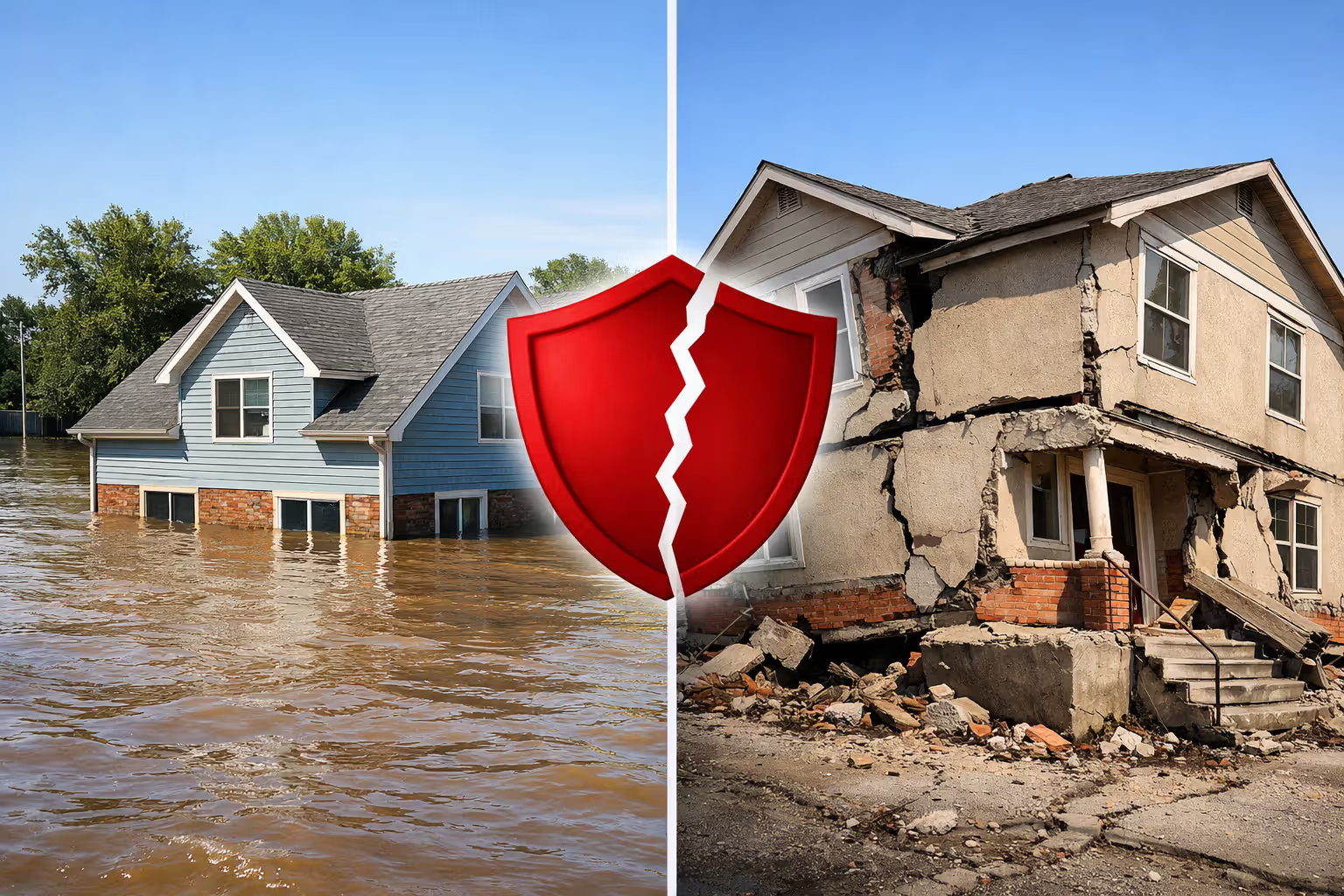
Natural disaster gaps (floods, earthquakes)
Standard homeowners policies exclude flood damage entirely. If a hurricane's storm surge floods your home, your policy won't pay a cent. If heavy rains overwhelm local drainage and water enters your basement, that's excluded too. The National Flood Insurance Program offers separate flood policies, but only 4% of homeowners outside high-risk flood zones carry this coverage.
Earthquake damage is similarly excluded in standard policies. Homeowners in California, Washington, and other seismically active regions need separate earthquake insurance. Even minor earthquakes can crack foundations and damage structures in ways that cost tens of thousands to repair.
The confusion multiplies because some water damage is covered while other water damage isn't. If wind tears off your roof and rain pours in, that's covered. If your sump pump fails and groundwater floods your basement, that's excluded under the flood exclusion. If a pipe bursts inside your wall, that's typically covered—but if the pipe burst because you neglected maintenance, the claim might be denied.
Author: Lauren Bishop;
Source: sixth-fleet.com
Maintenance-related damage
Homeowners policies cover sudden, accidental damage—not gradual deterioration or damage from neglect. If a tree falls on your roof during a storm, you're covered. If your roof has been leaking for months and you ignored it, leading to extensive water damage and mold, the insurer will deny your claim.
This exclusion trips up many homeowners. A slow leak under your kitchen sink that eventually rots the subfloor isn't covered. Termite damage isn't covered. Foundation cracks from settling aren't covered. Mold growth from long-term moisture problems isn't covered.
Insurers expect you to maintain your home in good condition. That means regular inspections, prompt repairs, and addressing issues before they become catastrophic. Document your maintenance with receipts and photos—if you ever need to prove a problem was sudden rather than gradual, this evidence becomes critical.
High-value item limitations
Standard policies cap coverage for certain valuable items. Jewelry might be limited to $1,500 total, regardless of your overall personal property coverage. Cash is typically limited to $200-$500. Collectibles, artwork, firearms, and other specialty items face similar sublimits.
If you own a $5,000 engagement ring and it's stolen, your standard policy will only pay $1,500. The remaining $3,500 is your loss. These sublimits apply even if you have $200,000 in personal property coverage—the lower limit for that specific category controls.
Business property used at home usually isn't covered, or coverage is minimal. If you run a home business and have $15,000 in computer equipment, photography gear, or inventory, your homeowners policy likely won't cover it. You need a business policy or a home business endorsement.
Deductible Structures: Finding the Right Balance Between Premium and Out-of-Pocket Costs
An insurance policy evaluation homeowners guide needs to explain how deductibles directly impact both your annual costs and potential claim payouts. The deductible is what you pay before insurance coverage kicks in.
Most policies offer flat-dollar deductibles ranging from $500 to $5,000. Choose a $1,000 deductible and you pay the first $1,000 of any covered claim. A higher deductible lowers your premium—sometimes by 25% or more when jumping from $500 to $2,500. But that means you need $2,500 available if disaster strikes.
Percentage deductibles work differently. Instead of a fixed dollar amount, you pay a percentage of your dwelling coverage. With a 2% deductible on a home insured for $400,000, you'd pay $8,000 out of pocket before coverage applies. Percentage deductibles typically range from 1-5%.
Hurricane deductibles are a special category in coastal states. These separate deductibles—almost always percentage-based—apply specifically to hurricane damage. You might have a $1,000 standard deductible but a 5% hurricane deductible. On a $300,000 policy, that hurricane deductible is $15,000. Hurricane deductibles trigger when the National Weather Service officially declares a hurricane, and they remain in effect for a set period (often 72 hours) after the storm passes.
The deductible choice involves real trade-offs. A $500 deductible might cost you $1,800 annually in premiums, while a $2,500 deductible might cost $1,200. You save $600 per year with the higher deductible. If you go five years without a claim, you've saved $3,000—more than the additional deductible amount. But if you need to file a claim in year one, you're out an extra $2,000 immediately.
Financial advisors generally recommend choosing the highest deductible you could comfortably pay from savings. This maximizes your premium savings over time. Just make sure you actually have that amount in accessible savings—putting a $5,000 deductible on a credit card at 20% interest defeats the purpose.

Author: Lauren Bishop;
Source: sixth-fleet.com
Policy Add-Ons and Endorsements Worth Considering
A policy comparison homeowners insurance features guide must examine optional coverages that address common gaps. These endorsements cost extra but provide protection standard policies exclude.
Water backup coverage
Water backup coverage protects against damage when water backs up through sewers or drains. This is different from flood insurance—it covers situations like when your main sewer line clogs and sewage backs up into your home, or when heavy rains overwhelm storm drains and water enters through floor drains.
Standard policies exclude this damage, but an endorsement typically costs $40-$250 annually and provides $5,000-$25,000 in coverage. Given that sewage cleanup can easily cost $10,000-$20,000 due to contamination and health hazards, this endorsement makes sense for most homeowners.
The coverage is especially valuable if you have a finished basement, live in an older neighborhood with aging sewer infrastructure, or have experienced drainage problems in the past. Some insurers now require homes with previous water backup claims to install backwater valves before offering this coverage.
Scheduled personal property
Scheduled personal property coverage (also called a floater or rider) eliminates sublimits on valuable items. You list specific items with their appraised values, and the insurer covers them for those amounts—usually without a deductible.
This endorsement makes sense for engagement rings, wedding bands, expensive watches, valuable art, collectibles, musical instruments, cameras, and other high-value items. You'll need appraisals or receipts documenting the items' values. The cost typically runs 1-3% of the insured value annually, so insuring a $10,000 ring might cost $100-$300 per year.
Scheduled items are often covered for more perils than under standard personal property coverage. Many policies cover scheduled items even if you lose them or they mysteriously disappear—coverage the base policy doesn't provide.
Inflation guard and extended replacement cost
Inflation guard automatically increases your dwelling coverage each year to keep pace with construction cost inflation. Without it, your coverage stays static while rebuilding costs rise. A home adequately insured at $350,000 in 2020 might need $425,000 in coverage by 2024 due to construction cost increases.
Inflation guard typically increases your coverage by 2-4% annually, with your premium adjusting accordingly. It's an inexpensive way to avoid becoming underinsured over time.
Extended replacement cost coverage pays above your dwelling coverage limit if rebuilding costs exceed expectations. Standard coverage pays up to your policy limit—if you're insured for $400,000 and rebuilding costs $450,000, you're $50,000 short. Extended replacement cost might pay 125% or 150% of your dwelling limit, giving you $500,000-$600,000 available.
This coverage costs more but protects against unexpected circumstances: a shortage of contractors after a widespread disaster, supply chain issues that increase material costs, or discovering during reconstruction that your home was larger or more complex than estimated. After major hurricanes or wildfires, construction costs in affected areas can spike 50% or more due to demand.

Author: Lauren Bishop;
Source: sixth-fleet.com
Red Flags When Comparing Insurance Quotes
Evaluating homeowners insurance policy terms guide and policy comparison homeowners insurance features guide skills help you spot problematic quotes. Unusually low premiums often signal coverage gaps or problematic policy terms.
When one quote is 30-40% cheaper than others, investigate carefully. The insurer might be offering actual cash value instead of replacement cost, lower dwelling coverage limits, higher deductibles, or excluding coverages others include as standard. A $1,200 annual premium looks attractive compared to $1,800 quotes—until you realize it provides $250,000 in dwelling coverage while the others provide $400,000.
Check the insurer's financial strength ratings through A.M. Best, Moody's, or Standard & Poor's. A cheap premium means nothing if the company can't pay claims. Stick with insurers rated A- or better. Several high-profile insurers have failed or stopped writing policies in disaster-prone states, leaving policyholders scrambling.
Watch for policies that exclude or severely limit coverage for perils common in your area. A Florida policy that excludes wind damage or a California policy with a 10% earthquake deductible might be cheap for a reason. Some insurers in wildfire-prone areas now exclude fire damage for homes near wildland areas or require expensive mitigation measures.
Examine the liability limits carefully. Some budget insurers offer only $25,000-$50,000 in liability coverage—woefully inadequate given modern lawsuit judgments. You want at minimum $300,000, and $500,000 is better. If you have significant assets, consider a $1 million umbrella policy that sits on top of your homeowners liability coverage.
Read the exclusions section. Some policies exclude dog bites (or exclude specific breeds), trampoline injuries, swimming pool accidents, or home business activities. If you have any of these risk factors, confirm they're covered.
Check claim handling reviews. An insurer might offer great coverage on paper but have a reputation for denying legitimate claims, slow payment, or requiring extensive documentation. Check consumer complaint ratios through your state insurance department and read reviews on independent sites.
FAQ: Home Insurance Policy Evaluation
Understanding what to look for in a home insurance policy transforms you from a passive consumer into an informed buyer. The coverage types, limits, exclusions, deductibles, and endorsements you choose directly determine whether your policy protects you or leaves you financially exposed when disaster strikes.
Start by ensuring your dwelling coverage reflects actual rebuilding costs, not market value. Choose replacement cost coverage for personal property if your budget allows. Understand exactly what your policy excludes—especially regarding water damage, natural disasters, and high-value items—and add endorsements to fill critical gaps.
Don't select coverage based solely on premium cost. The cheapest policy often provides the least protection when you need it most. Instead, focus on adequate coverage limits, reasonable deductibles you can afford to pay, and an insurer with strong financial ratings and good claim service reputation.
Review your policy annually, update coverage as your situation changes, and keep detailed home inventories with photos and receipts. The time you invest in understanding your coverage now prevents devastating financial surprises later. Your home is likely your largest asset—protect it with insurance coverage that actually works when you need it.