
Home insurance policy document on a wooden desk next to a small house model, calculator, and dollar bills
What Deductible Should You Choose for Home Insurance? A Complete Guide

Content
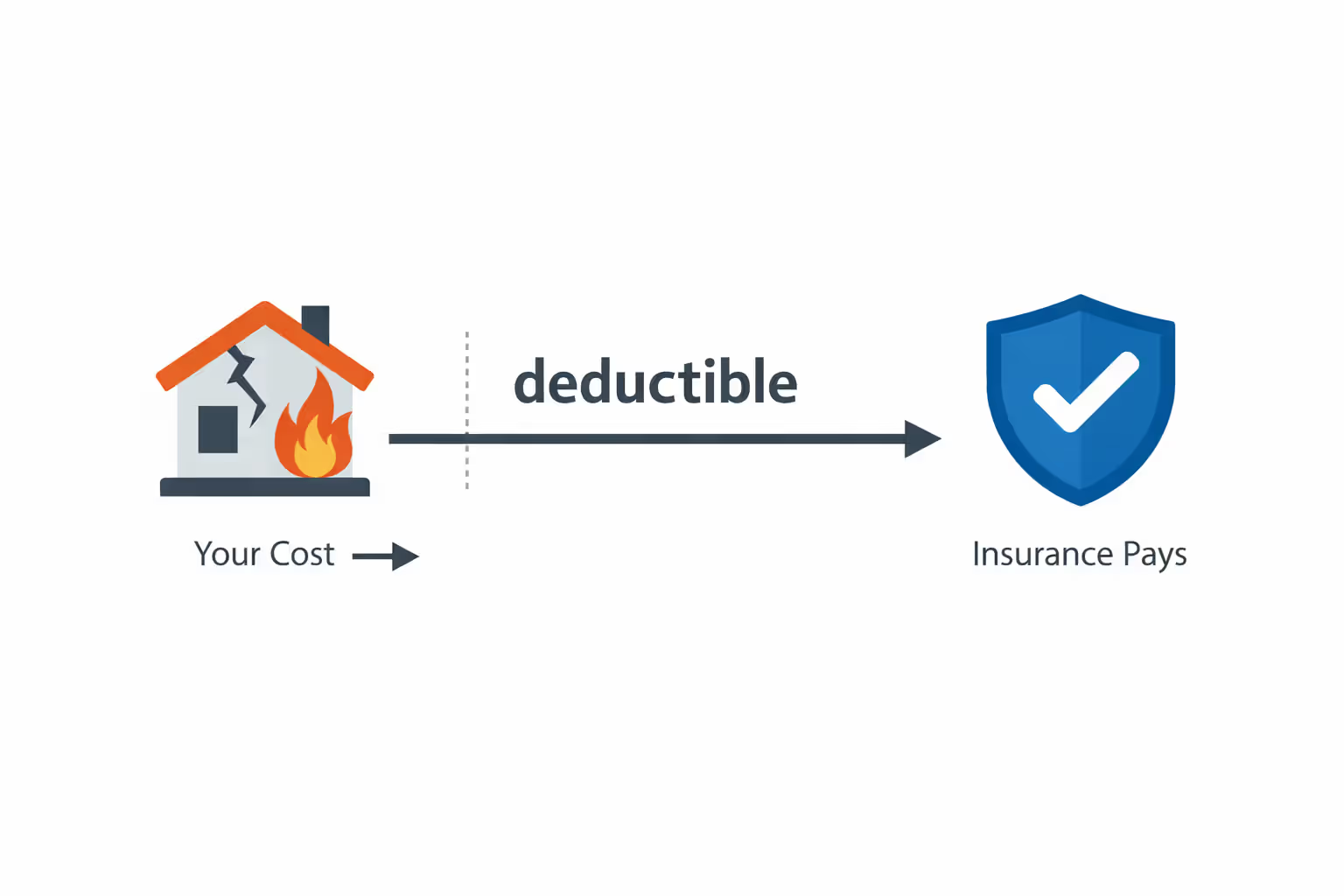
The deductible represents your share of any covered loss before insurance coverage begins. If a kitchen fire causes $8,000 in damage and you carry a $1,000 deductible, you pay the first $1,000 while your insurer covers the remaining $7,000. This seemingly simple arrangement becomes complex when you factor in premium differences, claim frequency, regional risks, and your personal financial situation.
How Home Insurance Deductibles Work
Your deductible applies each time you file a claim for covered property damage. Unlike health insurance with annual deductibles, home insurance deductibles reset with every separate incident. If you file three claims in one year—storm damage in March, a burst pipe in July, and fire damage in November—you'll pay your deductible three times.
The deductible never applies to liability claims. If someone slips on your icy walkway and sues for medical expenses, your liability coverage responds without any deductible. The same holds true for additional living expenses if you need temporary housing during repairs—most policies cover these costs without requiring you to meet a deductible first.
Author: Lauren Bishop;
Source: sixth-fleet.com
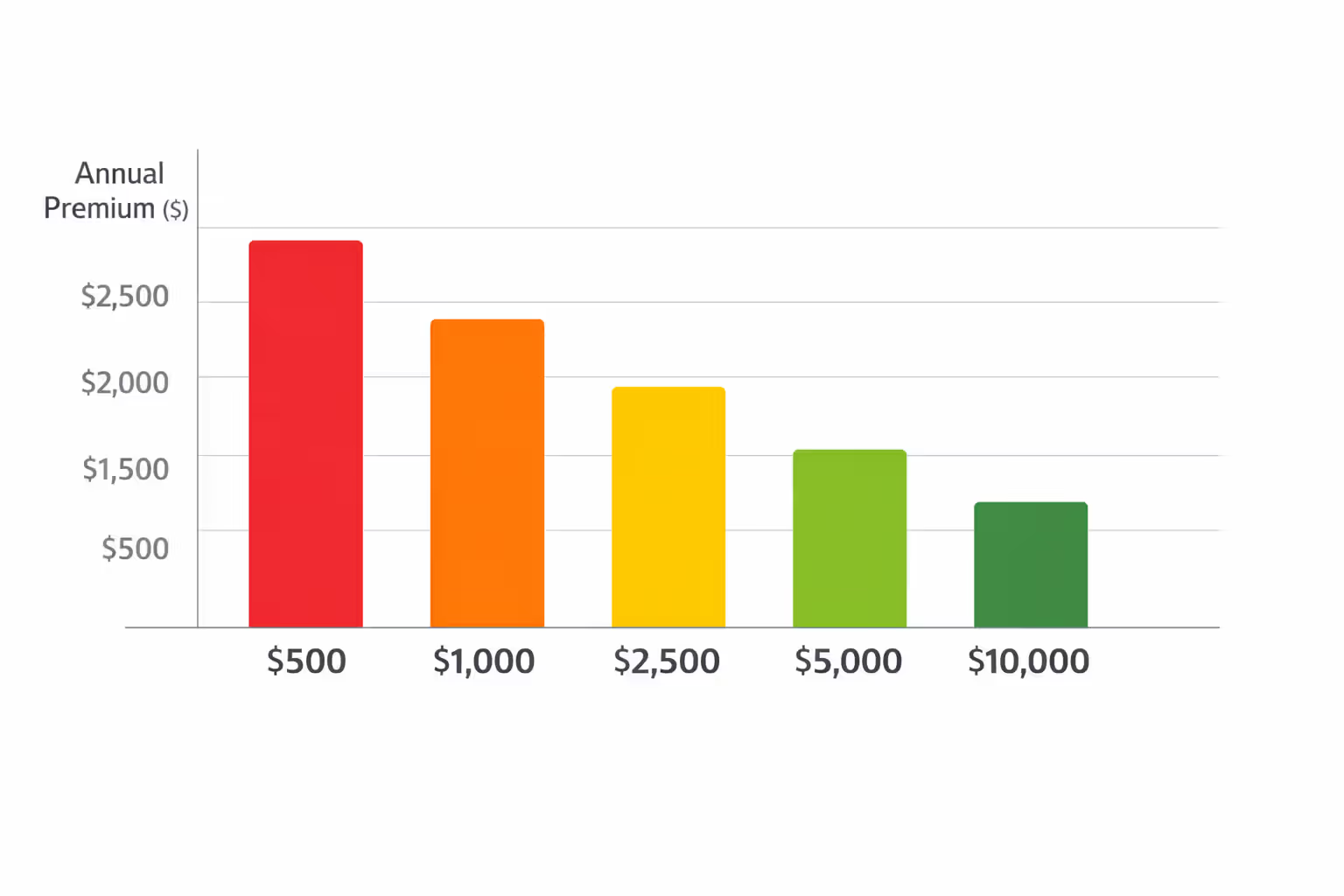
Insurance companies price policies using a simple inverse relationship: higher deductibles mean lower premiums. When you agree to shoulder more of the financial burden for small claims, insurers reduce your annual cost. A homeowner who increases their deductible from $500 to $2,500 might save $300-500 annually, recouping that higher out-of-pocket exposure after 4-7 years without a claim.
This pricing structure exists because most homeowners file claims infrequently. Industry data shows the average homeowner files a claim once every 9-10 years. Insurers spend significant administrative costs processing small claims, so they incentivize policyholders to handle minor repairs independently by offering meaningful premium discounts for higher deductibles.
Standard Deductible Options Available to Homeowners
Most insurance carriers offer flat dollar deductibles ranging from $500 to $10,000, though $1,000 and $2,500 represent the most common choices. When you request a quote, the insurer typically defaults to $1,000 unless you specify otherwise. The deductible options for homeowners insurance policies have expanded in recent years as carriers seek to provide more flexibility for different financial profiles.
Percentage-based deductibles calculate your out-of-pocket cost as a percentage of your dwelling coverage limit. If you insure your home for $400,000 and carry a 2% deductible, you'll pay $8,000 toward any claim. These percentage deductibles typically range from 1% to 5% and most commonly apply in coastal regions prone to hurricanes or in areas with high windstorm risk.
Special peril deductibles add another layer of complexity. Many coastal policies include separate wind and hail deductibles—often 2% to 5% of dwelling coverage—that apply instead of your standard deductible when these specific perils cause damage. Hurricane deductibles activate when the National Weather Service declares a hurricane warning in your area. Earthquake coverage, sold as a separate endorsement or policy in most states, typically carries its own deductible ranging from 10% to 25% of dwelling coverage.
The deductible structure for homeowners insurance in high-risk areas often includes these multiple tiers. A Florida homeowner might carry a $2,500 standard deductible, a 2% hurricane deductible ($6,000 on a $300,000 home), and a 10% earthquake deductible if they add that coverage. Understanding which deductible applies to which scenario prevents unpleasant surprises during the claims process.
Deductible Amount Comparison Table
| Deductible | Annual Premium ($300K Home) | Annual Savings vs. $500 | Out-of-Pocket at Claim | Break-Even (Years Without Claim) |
| $500 | $1,800 | $0 | $500 | Baseline |
| $1,000 | $1,550 | $250 | $1,000 | 2.0 |
| $2,500 | $1,300 | $500 | $2,500 | 4.0 |
| $5,000 | $1,150 | $650 | $5,000 | 6.9 |
| $10,000 | $1,050 | $750 | $10,000 | 12.7 |
Premium estimates based on national averages for a standard HO-3 policy with $300,000 dwelling coverage. Actual rates vary by location, claims history, and carrier.
How to Calculate the Right Deductible for Your Financial Situation
The emergency fund assessment method provides the most straightforward approach. Financial advisors generally recommend keeping 3-6 months of expenses in readily accessible savings. If you maintain a healthy emergency fund, you can comfortably select a deductible equal to one month's expenses without jeopardizing your financial stability. A household with $5,000 monthly expenses and $20,000 in savings could reasonably choose a $5,000 deductible.
Break-even analysis reveals the timeline for recouping a higher deductible through premium savings. Calculate the additional out-of-pocket exposure, then divide by annual savings. If raising your deductible from $1,000 to $2,500 saves $400 annually, you'll break even after 3.75 years without a claim ($1,500 additional exposure ÷ $400 savings). Since most homeowners file claims less frequently than once per decade, this math favors higher deductibles for those with adequate savings.
Risk tolerance extends beyond pure mathematics. Some homeowners sleep better knowing they face minimal out-of-pocket costs after a loss, even if that peace of mind costs $500 extra annually. Others view insurance as protection against catastrophic losses only and prefer maximizing premium savings. Neither approach is wrong—your comfort level with financial uncertainty should influence the decision.
The purpose of insurance is to protect against catastrophic financial loss, not to prepay for every minor inconvenience. A well-chosen deductible reflects your true financial resilience — it forces you to ask how much risk you can genuinely absorb, and that honest self-assessment is the foundation of every sound insurance strategy.
— Dave Ramsey
Home value and replacement cost considerations matter particularly for percentage-based deductibles. A 2% deductible on a $200,000 home equals $4,000, but the same percentage on a $600,000 home means $12,000 out-of-pocket. High-value homeowners should carefully evaluate whether percentage deductibles align with their available cash reserves, especially in regions where carriers mandate these structures for wind coverage.
Common Mistakes Homeowners Make When Selecting Their Deductible
Keeping a $500 deductible year after year represents one of the costliest errors. The premium difference between $500 and $2,500 deductibles often exceeds $400-600 annually. Over a 10-year period without claims, that's $4,000-6,000 in unnecessary premium payments—enough to cover multiple deductibles. Many homeowners maintain low deductibles from habit rather than conscious choice, never questioning the default selection from their initial policy purchase.
The opposite mistake—selecting a $5,000 or $10,000 deductible without corresponding savings—creates genuine financial hardship after a loss. A homeowner who chooses a high deductible to minimize premiums but lacks the cash reserves to fund repairs faces difficult choices: taking high-interest loans, delaying necessary repairs, or draining retirement accounts. The deductible should never exceed your readily available emergency savings.

Author: Lauren Bishop;
Source: sixth-fleet.com
Separate deductibles for specific perils catch many homeowners off guard. A Texas homeowner might select a comfortable $1,500 standard deductible, unaware their policy includes a 2% wind and hail deductible. When a hailstorm damages their $350,000 home, they discover they owe $7,000 instead of $1,500. Always request a complete explanation of all deductibles in your policy, particularly for wind, hail, and hurricane coverage.
Failing to review your deductible after major life changes leads to misaligned coverage. A young couple who selected a $5,000 deductible when both worked full-time might need to reduce it after one spouse leaves the workforce. Similarly, homeowners who build substantial savings over time should consider increasing their deductible to capture premium savings they can now comfortably afford.
Deductible Planning: When to Adjust Your Coverage
Life events that improve your financial position warrant deductible increases. Receiving an inheritance, paying off your mortgage, or earning a significant raise all create opportunities to raise your deductible and reduce premiums. When you accumulate an extra $5,000 in savings beyond your existing emergency fund, consider increasing your deductible by a corresponding amount—you're essentially self-insuring that portion of potential losses while keeping the premium savings.
Market conditions and premium increases provide natural review points. When your insurer raises rates at renewal, request quotes with various deductible levels. Sometimes a premium increase paired with a deductible adjustment results in a net cost similar to your previous policy. If your premium jumps from $1,400 to $1,700 annually, increasing your deductible from $1,000 to $2,500 might bring the cost back to $1,450—a modest increase that's easier to absorb.
Building emergency savings creates the perfect opportunity for deductible planning for homeowners insurance policies. Many households start with minimal savings and low deductibles, then gradually increase both. A reasonable progression might involve starting with a $1,000 deductible, moving to $2,500 after accumulating $10,000 in savings, then advancing to $5,000 once emergency funds reach $20,000. This staged approach aligns insurance costs with financial capacity.
Regional risk factors demand periodic reassessment. Homeowners in hurricane zones should evaluate their wind deductibles before each hurricane season, particularly if they've renovated or added home value. Those in wildfire-prone areas might adjust deductibles based on recent fire activity and changing insurance markets. California homeowners facing non-renewed policies often accept higher deductibles to secure replacement coverage in a constrained market.
Too many policyholders set their deductible once and never revisit it, even as their financial lives change dramatically. Your deductible should evolve alongside your savings, your home’s value, and the risk environment you live in. A static insurance plan in a dynamic world is a recipe for either overpaying or being dangerously underinsured
— Loretta Worters
How Different Deductible Levels Affect Your Premium and Claims
Premium savings follow predictable patterns across deductible levels for homeowners insurance policies. The jump from $500 to $1,000 typically saves 12-15% on premiums. Moving from $1,000 to $2,500 adds another 15-18% savings. However, savings diminish at higher levels—the difference between $5,000 and $10,000 deductibles might only reduce premiums by 5-8%. The sweet spot for most homeowners falls between $1,500 and $2,500, balancing meaningful savings against manageable out-of-pocket exposure.
Author: Lauren Bishop;
Source: sixth-fleet.com
Real claim scenarios illustrate the practical impact. Consider a $15,000 roof replacement after storm damage:
- With a $1,000 deductible: You pay $1,000, insurance pays $14,000
- With a $2,500 deductible: You pay $2,500, insurance pays $12,500
- With a $5,000 deductible: You pay $5,000, insurance pays $10,000
The $1,500 difference between the $1,000 and $2,500 scenarios represents 3-4 years of premium savings. Unless you file claims more frequently than once every 3-4 years, the higher deductible costs less over time.
Long-term cost projections reveal the cumulative impact of deductible choices. A homeowner paying $1,800 annually with a $500 deductible spends $18,000 over 10 years. If they file one $10,000 claim during that period, their total cost is $18,500 ($18,000 premiums + $500 deductible). Compare this to a $2,500 deductible at $1,300 annually: $13,000 in premiums plus $2,500 for the claim equals $15,500 total—a $3,000 savings despite the higher deductible.
According to Robert Hunter, former Texas Insurance Commissioner and insurance expert at the Consumer Federation of America: "Homeowners should carry the highest deductible they can comfortably afford to pay out of savings. Insurance works best as protection against losses that would be financially devastating, not as a payment plan for predictable maintenance and minor repairs. A $2,500 deductible isn't financially devastating for most homeowners, but it significantly reduces premium costs over time."
The deductible comparison for homeowners insurance policies becomes more complex when factoring in claim frequency and severity. Homeowners who file frequent small claims face non-renewal or substantial rate increases regardless of deductible level. Those who avoid filing claims for minor losses benefit doubly from higher deductibles—they save on premiums and avoid the claims history that triggers rate increases.
Frequently Asked Questions About Home Insurance Deductibles
Making Your Deductible Decision
Your home insurance deductible represents a personal financial decision that balances premium savings against out-of-pocket risk. The mathematically optimal choice for most homeowners falls between $1,500 and $2,500—high enough to capture meaningful premium discounts, yet manageable for households with modest emergency savings.
Start by assessing your emergency fund. If you maintain 3-6 months of expenses in readily accessible savings, select a deductible equal to roughly one month's expenses. Run break-even calculations to understand how long you'd need to go without a claim to recoup a higher deductible through premium savings. Since the average homeowner files a claim once per decade, time favors those who choose higher deductibles and adequate savings.
Review your deductible annually at policy renewal, particularly after life changes that affect your financial situation. Building savings, receiving windfalls, or paying off debt all create opportunities to increase your deductible and reduce premiums. Conversely, job changes or increased expenses might warrant temporarily reducing your deductible until your financial situation stabilizes.
Request a complete explanation of all deductibles in your policy, especially separate wind, hurricane, or earthquake deductibles common in certain regions. These special peril deductibles can dramatically exceed your standard deductible, creating unexpected financial burdens if you're unaware of their existence.
The right deductible protects you from financial catastrophe while avoiding unnecessary premium expenses. Insurance should cover losses that would genuinely strain your finances, not serve as a payment plan for routine repairs. Choose a deductible you can afford to pay from savings without hardship, then keep those premiums savings working for you year after year.