
Homeowners insurance policy document with calculator, miniature house model, and dollar bills on a wooden desk
How to Calculate Home Insurance Premium: A Step-by-Step Guide

Content
Let's be honest—when your insurance bill arrives, do you know why it's $1,200 instead of $900? Most folks don't. They just pay it and move on. But here's the thing: insurers aren't pulling numbers from thin air. There's actual math behind that annual cost, and once you understand it, you've got real power to change what you pay.
Your premium reflects dozens of specific details about your property, where it sits, and even your personal financial habits. Companies plug these details into their pricing systems, which crunch the numbers and spit out what you owe. Different insurers weight these factors differently, which explains why you might get quotes ranging from $850 to $1,400 for the same house.
"Consumers often believe premium calculations are opaque black boxes, but the reality is that every dollar of premium charged is tied to a measurable risk factor," explains Robert Hartwig, an insurance economist and former president of the Insurance Information Institute. "The challenge is that dozens of variables interact simultaneously, making it difficult for homeowners to reverse-engineer their exact premium without industry tools."
What follows is your roadmap. We'll decode the formulas, walk through real calculations, and show you exactly where you can squeeze savings from your next policy.
What Goes Into Your Homeowners Insurance Premium?
Think of premium calculation homeowners insurance factors as falling into three buckets: what your house is made of, where it's located, and who you are as a policyholder.
The first bucket—property details—includes stuff like how old your house is, what materials the builder used, how many square feet you're protecting, whether your roof is new or ancient, and what security gear you've installed. A 2,000-square-foot brick ranch from 2015 with a roof that's only five years old? That's a completely different risk picture than a 2,000-square-foot wood-sided Victorian from 1960 with a roof celebrating its 20th birthday.
Location matters enormously. Your distance from the nearest fire hydrant, how far firefighters have to drive to reach you, hurricane frequency if you're coastal, tornado patterns if you're in the Midwest, wildfire danger out West—all of it feeds into your price. Sometimes identical houses separated by a county line see premiums that differ by $300 or more annually.
Then there's the personal stuff. Your credit-based insurance score (yeah, they check that), whether you've filed claims recently, and your track record of keeping continuous coverage all signal to insurers how risky you are to insure.
Companies feed everything into their algorithms, which calculate a starting price, then stack on discounts or pile on surcharges depending on your specifics. That final number includes their expected claims costs plus overhead and profit margin.
The Core Formula Insurance Companies Use
While every carrier has their own secret sauce, the basic homeowners insurance premium formula looks like this:
Base Rate × Risk Adjustments × Coverage Amount ÷ 1,000 = Starting Premium
Then: Starting Premium + Extra Coverages - Discounts = What You Actually Pay
Base Rate Calculation
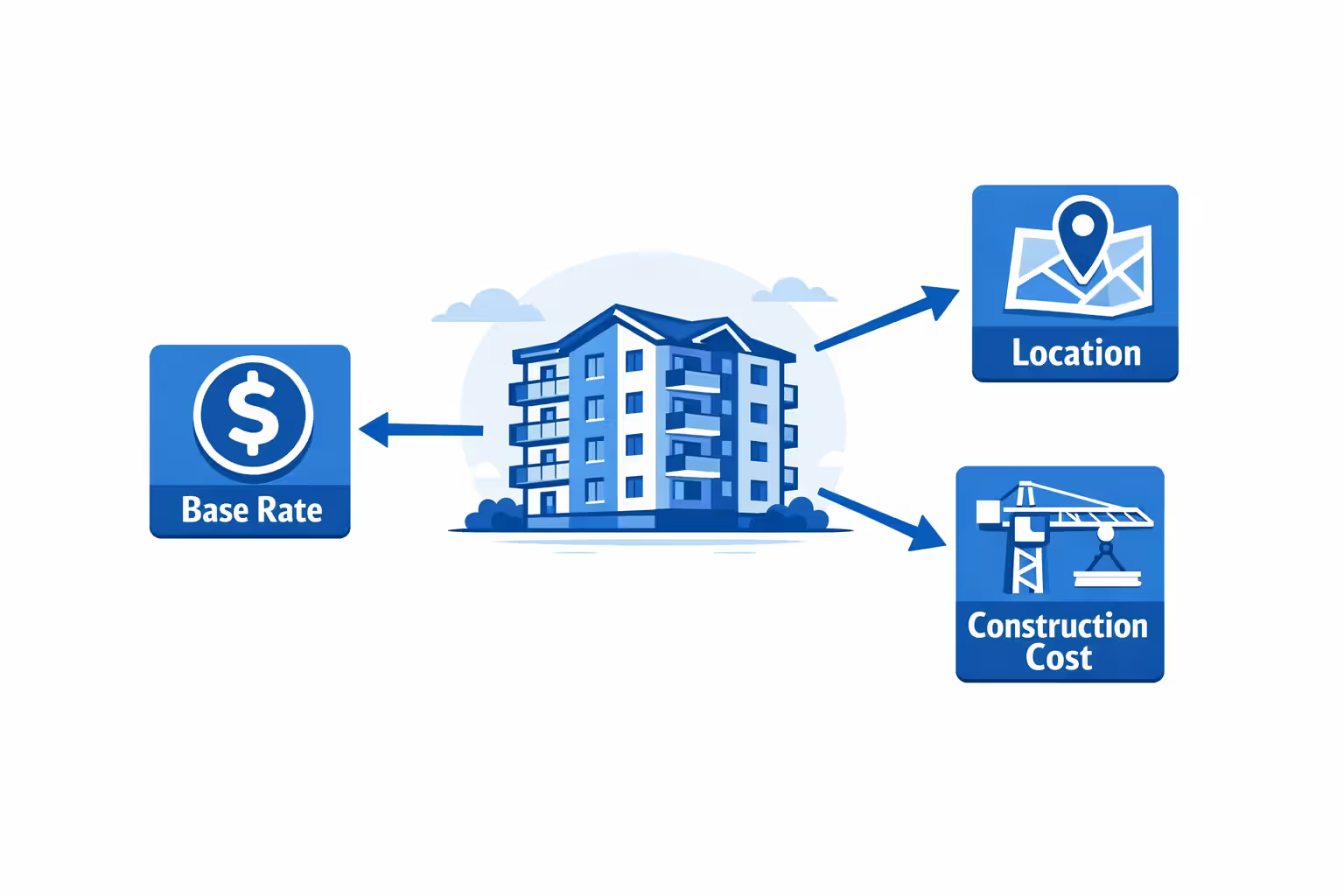
Your base rate is what it costs per $1,000 of dwelling coverage for an average property in your neighborhood. Say your insurer charges $1.20 per thousand and you need $250,000 to rebuild your house. Your starting point:
$1.20 × 250 = $300
That base rate already bakes in broad location factors—regional weather patterns, local construction costs, how often people around you file claims. Coastal Florida might run $2.80 per thousand. Rural Ohio? Maybe $0.85.
Author: Samantha Kessler;
Source: sixth-fleet.com
Applied Multipliers and Adjustments
After that baseline, insurers layer on adjustments for your specific risk factors:
Construction adjustments: Wood frame might bump your cost up 15%. Brick veneer might be neutral. Full masonry construction could cut it by 8%.
Age adjustments: Houses under 10 years old might get a 10% reduction. Over 50 years old? Could be a 25% increase.
Fire protection adjustments: Live within 1,000 feet of a hydrant and five miles of a station? Maybe 15% off. Out in the country with fire trucks 10+ miles away? You might see a 40% increase.
Let's keep going with that $300 starting figure:
$300 × 1.15 (wood frame) × 1.10 (25-year-old house) × 0.95 (decent fire protection) = $360
Now tack on liability coverage, personal property protection, loss-of-use coverage, any special endorsements you want. Subtract whatever discounts you qualify for. That's your final bill.
8 Key Factors That Determine Your Premium Cost
Premium variables homeowners insurance companies care most about:
1. Location and Geographic Risk
Your address determines everything from natural disaster exposure to local crime stats to how quickly help can arrive. Houses in California's wildfire zones or Gulf Coast hurricane alleys pay dramatically more than properties in low-risk regions. Even within the same city, different neighborhoods might vary by 20-30% based solely on fire protection ratings and historical claims data from that area.
2. Dwelling Coverage Amount
This is what it'd cost to rebuild your entire house from scratch. It forms the foundation of your premium calculation. More coverage equals higher premiums, but the relationship isn't perfectly proportional. Bumping coverage from $200,000 to $250,000 might cost you $80 more annually. Going from $250,000 to $300,000? Maybe just $65 more, since the per-thousand rate often drops at higher coverage levels.
3. Home Age and Condition
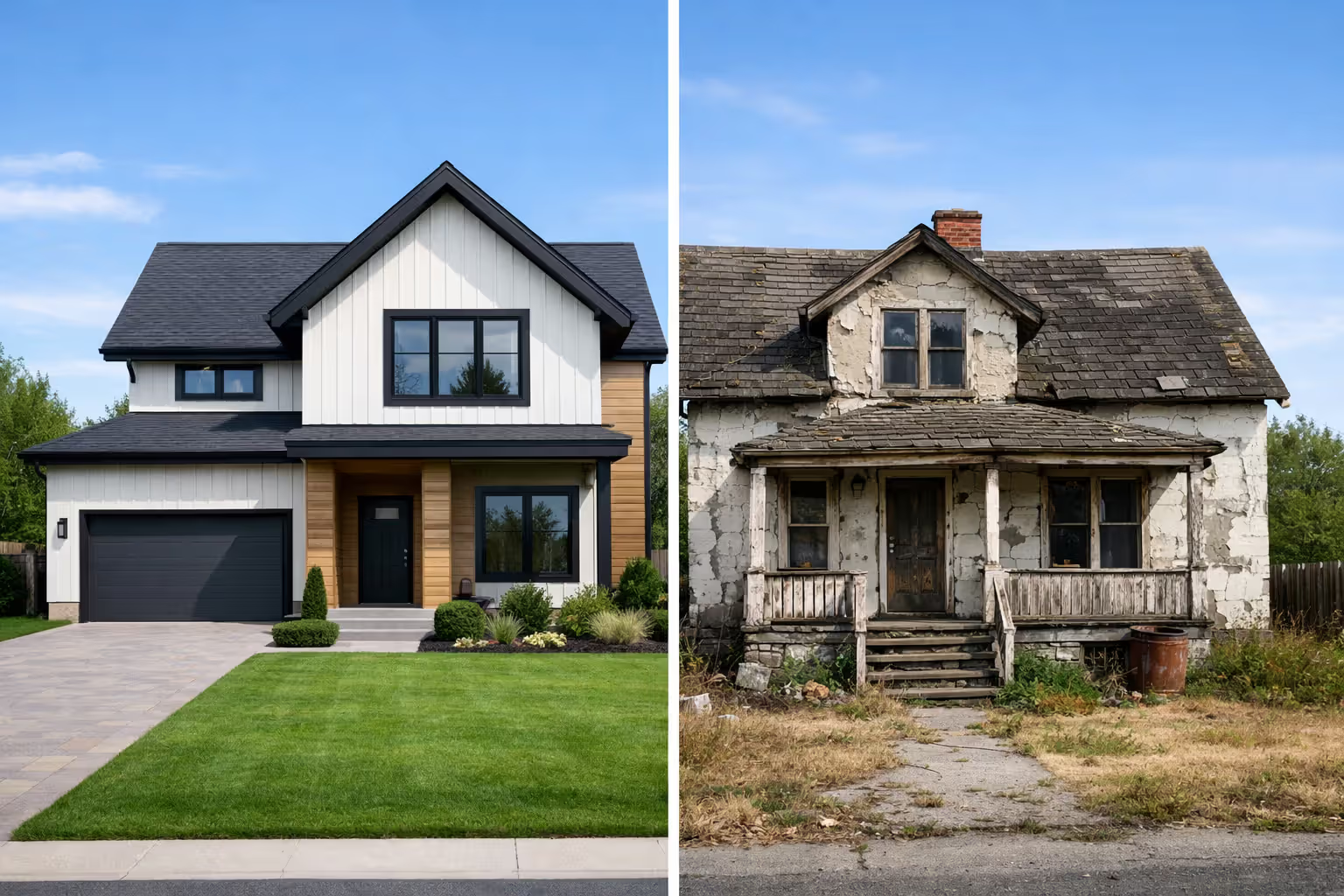
Older properties cost more because aging systems fail more often. A 60-year-old house might run 40-60% more than a 10-year-old house identical in every other way. But wait—if that older house has updated wiring, new plumbing, and a recent roof replacement, insurers will cut you some slack. Those updates can narrow the age penalty considerably.
Author: Samantha Kessler;
Source: sixth-fleet.com
4. Construction Type and Materials
Wood-frame construction (which most houses are) serves as the baseline. Full masonry typically knocks 5-15% off your premium. Fire-resistant exterior materials like brick or stone beat vinyl siding or wood shake in the insurer's eyes. Your roof is huge here: standard architectural shingles are neutral, impact-resistant shingles can earn 10-30% discounts in hail country, and wood shake roofs might jack up your cost by 20%—or make you uninsurable with some carriers.
5. Deductible Selection
Higher deductible means lower premium, period. Jump from a $500 deductible to $2,500 and you might cut your premium by 25-35%. Go to $5,000? Could be 35-45% savings. The trade-off is obvious: you're betting you can cover more out-of-pocket if something happens. For anyone with solid emergency savings, higher deductibles usually make financial sense.
The single most effective thing a homeowner can do to reduce insurance costs is to take a higher deductible. It aligns your interests with the insurer’s — you both want to avoid small claims — and that behavioral shift alone can save thousands over a decade
— Warren Buffett
6. Credit-Based Insurance Score
Most states let insurers peek at your credit to predict claim likelihood. Someone with excellent credit might pay 30-50% less than someone with poor credit—same house, same coverage. This isn't your regular FICO score; it's a specialized insurance score that focuses heavily on payment patterns and how much of your available credit you're using. Improving your credit can slash your premium faster than almost any other move.
7. Claims History
File even one claim in the past three to five years? Expect a 10-30% increase. Two claims might bump you 30-50%. Three or more and you're looking at either massive premiums or carriers refusing to cover you at all. Insurers treat claims history as the single best predictor of future claims. That's why savvy homeowners eat the cost of minor repairs rather than file claims for amounts barely above their deductible.
8. Protective Devices and Security Features
Monitored burglar alarms typically earn 5-10% discounts. Monitored fire alarms can drop your cost by 10-15%. Full sprinkler systems might save 15-20%. Basic stuff like deadbolts and smoke detectors? Often required, might provide tiny credits. If you're coastal, wind mitigation features—hurricane shutters, reinforced roof connections—can slash premiums by 20-40%.
Premium Factor Comparison: What Matters Most
| Factor | How Much It Affects Cost | Range of Cost Difference | Can You Change It? |
| Where Your House Sits | Massive | Doubles or triples between regions | Nope (unless you move) |
| Coverage Limit You Pick | Massive | About $40-80 per $50K added | Yes (you decide) |
| How Old Your House Is | Pretty Big | 30-60% more for 50+ years | Nope (fixed) |
| What It's Built From | Moderate | 10-20% swing | Nope (fixed) |
| Deductible You Choose | Big | 25-45% difference ($500 to $5,000) | Yes (your call) |
| Your Credit Profile | Massive | 30-50% (excellent vs. poor) | Somewhat (takes time) |
| Past Claims You've Filed | Huge | 20-50% per claim | Somewhat (affects future behavior) |
| Security Systems Installed | Moderate | 5-20% per type | Yes (you can add these) |
| Roof Condition and Type | Moderate | 15-30% for aging roofs | Somewhat (you can replace) |
| Distance to Firefighters | Pretty Big | 20-40% depending on response time | Nope (unless you move) |
Step-by-Step: Estimating Your Own Premium
Want to ballpark your costs before calling for quotes? Here's how to estimate homeowners insurance premium expenses yourself.
Step 1: Figure Out Your Rebuild Cost
Forget market value—that includes the land. You need to know what rebuilding just the structure would cost today. Take your home's square footage and multiply by current local construction costs. In 2024, most areas run $120-180 per square foot for standard homes (higher in expensive markets, lower in cheap ones). A 2,000-square-foot house at $150 per square foot needs $300,000 dwelling coverage.
Step 2: Research What People in Your Area Pay
Exact base rates are company secrets, but you can estimate. Look up your state's average annual premium and average coverage amount. If your state averages $1,200 yearly for $250,000 coverage, the rough base rate is $1,200 ÷ 250 = $4.80 per thousand. Now you've got a starting number to work with.

Author: Samantha Kessler;
Source: sixth-fleet.com
Step 3: Adjust for What Makes Your House Different
Account for the factors you know about: - Wood frame construction: add 10-15% - House age 20-30 years: add 15-25% - House age 30-50 years: add 25-40% - Great fire protection (close to hydrant/station): subtract 5-10% - Lousy fire protection (rural, far from help): add 20-40% - High-risk region (coastline, wildfire zone): add 30-100%
Step 4: Run Your Numbers for Base Coverage
Let's try a 2,000-square-foot wood frame house from 1995 (29 years old now) needing $300,000 coverage. Your area's estimated base rate is $4.80 per thousand. Fire protection is good.
$4.80 × 300 = $1,440 before adjustments $1,440 × 1.12 (frame) × 1.20 (age) × 0.95 (fire protection) = $1,840
Step 5: Tack On Everything Else
Personal property coverage (usually 50-70% of dwelling value): $150-200 Liability protection ($300,000 is standard): $100-150 Loss of use (often 20% of dwelling): typically included Medical payments to others ($5,000 typical): $25-40
Total extra coverage: about $275-390
Step 6: Subtract What You Qualify For
Bundling home and auto: cuts 15-25% Security system: cuts 5-10% No recent claims: cuts 10-20% $2,500 deductible instead of $500: cuts 20-30%
Say you bundle (25% off) and have a security system (10% off): $1,840 × 0.65 (35% total savings) = $1,196
Add back that extra coverage: $1,196 + $330 = roughly $1,526 per year
Your actual quote won't match perfectly—insurers track way more variables than you can see—but you should land within 15-20% of this estimate.
Common Premium Calculation Mistakes Homeowners Make
Mixing Up Market Value and Rebuild Cost
What your house would sell for includes the land underneath it and fluctuates with real estate markets. Rebuild cost only covers the structure and depends on current construction prices. Insuring for market value usually means you're underinsured by 20-40%. After a total loss, you'd be stuck covering the gap. Calculate rebuild cost using today's construction prices per square foot, not Zillow's estimate of what you could sell for.
Forgetting That Construction Costs Keep Rising
Construction costs climb 3-5% every year. Buy a policy three years back with $250,000 dwelling coverage and never touch it? Today's actual rebuild cost might be $280,000. Some carriers offer automatic inflation adjustments that bump your coverage annually by a set percentage, but you still need to verify it's keeping up with real construction cost increases in your market.
Insurance is not just about price — it is about the promise behind the policy. Homeowners who focus exclusively on minimizing premiums often discover too late that they’ve also minimized the protection their family actually depends on when catastrophe strikes
— Janet Ruiz
Defaulting to the Lowest Deductible Without Doing Math
A $500 deductible costs way more than $2,500, yet people often pick it reflexively. Do the math: if the premium difference is $300 per year, you'd need to file a claim every 6-7 years just to break even. Since filing claims jacks up future premiums anyway, higher deductibles win financially for anyone with decent emergency savings.
Not Telling Your Insurer About Home Improvements
Update your electrical panel, slap on a new roof, or install a monitored security system? Your risk profile just changed, but insurers don't magically know about it. You're missing out on discounts worth hundreds annually if you don't speak up. On the flip side, finish your basement or add square footage without updating coverage? You're underinsured and don't know it.
Shopping on Price Alone
Two policies with identical premiums can deliver wildly different value. One might include guaranteed replacement cost (they'll pay whatever rebuilding actually costs), while another caps out at 125% of your dwelling limit. One covers water backup; another excludes it. Focus on what you're actually getting, not just the bottom-line number.
How to Lower Your Calculated Premium
These moves directly attack the factors insurers use:
Raise Your Deductible Strategically
Figure out your annual savings from bumping the deductible up, then calculate how many claim-free years you'd need to recover that higher out-of-pocket exposure. If going from $1,000 to $2,500 saves you $250 yearly, you break even in six years if you file one claim. Given that claims jack up your rates for 3-5 years afterward, the higher deductible almost always wins long-term.
Bundle Multiple Policies
Combine home and auto with one carrier and you'll typically cut your homeowners premium by 15-25%. Insurers love this because you're stickier as a customer and they save marketing costs. Shop the bundled price from multiple carriers instead of assuming your current auto insurer gives the best deal.
Fix Your Credit Profile
Pay everything on time, get credit card balances under 30% of your limits, don't open random new accounts. Credit-based insurance scores get refreshed regularly, so improvements can cut your renewal premium. Some people see 10-15% drops within 12-18 months of credit cleanup.
Add Monitored Security and Fire Systems
A monitored burglar alarm (5-10% discount) plus monitored fire/smoke detection (10-15% discount) can combine for 15-25% savings. If the monitoring runs $30-50 monthly but saves you $400-600 yearly on insurance, it basically pays for itself while adding real security and convenience.

Author: Samantha Kessler;
Source: sixth-fleet.com
Replace Old Systems Before They Cause Problems
Put a new roof on before the old one leaks. Update that 40-year-old electrical panel before it causes trouble. Replace ancient plumbing before it bursts. You accomplish two things: avoid filing claims that would spike your premiums, and qualify for credits for newer systems. Those savings compound year after year.
Review Everything Annually and Get New Quotes Every 2-3 Years
Insurance companies constantly tweak their pricing models. A carrier that was competitive three years ago might now be 20% higher than competitors. Meanwhile, a carrier that was expensive back then might now offer great rates. You don't need to switch annually, but comparing quotes every few years prevents you from overpaying due to pricing drift.
Frequently Asked Questions About Premium Calculations
Understanding Your Premium Puts You in Control
Your homeowners insurance premium isn't random. It reflects a systematic evaluation of measurable risks translated into dollars through mathematical formulas. Insurance companies aren't throwing darts at a board—they're quantifying specific variables and applying consistent calculations.
Once you grasp which factors drive your cost up or down, you gain leverage. You'll spot legitimate ways to reduce expenses without sacrificing protection. You'll recognize when quotes seem off. You'll make smarter decisions about coverage limits and deductibles.
The truly expensive insurance isn't the policy with the highest premium—it's the one that fails to protect you when disaster hits. Balance cost against coverage quality. Maintain adequate dwelling limits reflecting true replacement costs. Pick deductibles that match your financial reserves.
Make it a habit: review your coverage annually, shop competitors every few years, and notify your insurer when you upgrade systems that reduce risk. These practices ensure your premium accurately reflects your current situation and prevents overpaying for essential protection.